
Syrian Rice Pudding (Ruz bi-Haleeb): A Thousand-Year Heritage from the Abbasid Kitchen to the Aleppan Table

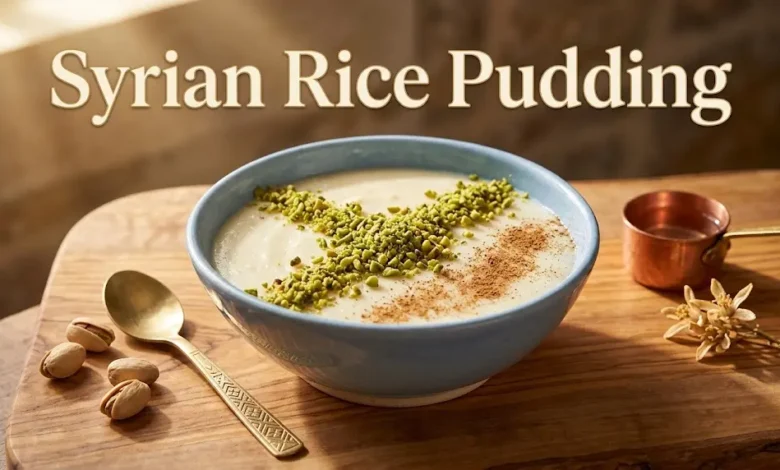
There’s a particular smell that rises from a pot of rice pudding when it’s done right — and I say “done right” with full awareness that half the Syrian women I know would disagree with each other about what that actually means. It’s not sweet, exactly. Not milky either, though milk is most of what it is. It’s something older than both those descriptors. Warmer. The smell of something that has been made, in roughly this way, since before anyone thought to write it down — and then, eventually, someone did.
Dr. Salma Yasser Al-Halabi — Anthropologist & Heritage Researcher
Dr. Nadeem Omar Al-Atassi — Syrian Heritage & Linguistics Expert
Archaeologist Abdul Hamid Raed Hindawi — Historical Reviewer
- Syrian rice pudding is documented in Arabic manuscripts since the 10th century CE, making it one of the oldest continuously prepared sweet dishes in the Levant.
- The earliest recipe appears in Ibn al-Warraq’s Kitab al-Tabikh, attributed to Caliph al-Wathiq billah (ruled 842–847 CE).
- The Aleppan version, al-Ma’muniyya, was recorded by Ibn al-Adim in the 13th century using pounded rice flour, Awassi sheep tail fat, Egyptian sugar, and Aleppo pistachios.
- 10th century CE: Baghdad / Samarra — Ibn al-Warraq’s cookbook, 132 chapters and 615 recipes.
- 13th century CE: Aleppo — Ibn al-Adim’s Al-Wusla ila al-Habib, recipe 5.7.
- 1987: Brill / Finnish Oriental Society critical edition by Öhrnberg and Mroueh (Uppsala manuscript).
- 2022: DGAM report — over 40% of Aleppo manuscript collections sustained partial or total damage.
That someone was Ibn Siyyar al-Warraq, a Baghdad scribe working in the fourth Islamic century, approximately the tenth century CE. He recorded a recipe called Aruzz bi-Laban lil-Wathiq — rice with milk, attributed to the Abbasid Caliph al-Wathiq billah, who ruled from 842 to 847 CE. The recipe appears on page 229 of his Kitab al-Tabikh, the oldest complete Arabic cookbook known to have survived to this day: 132 chapters, 615 recipes, and sitting in European libraries for centuries before anyone published it properly. The Swedish orientalist Kaj Öhrnberg co-edited the critical edition, published by Brill in 1987.
That’s the thing about Syrian food history. The documents exist. They’ve just been waiting.
What the Manuscripts Actually Say (And What We Keep Getting Wrong)
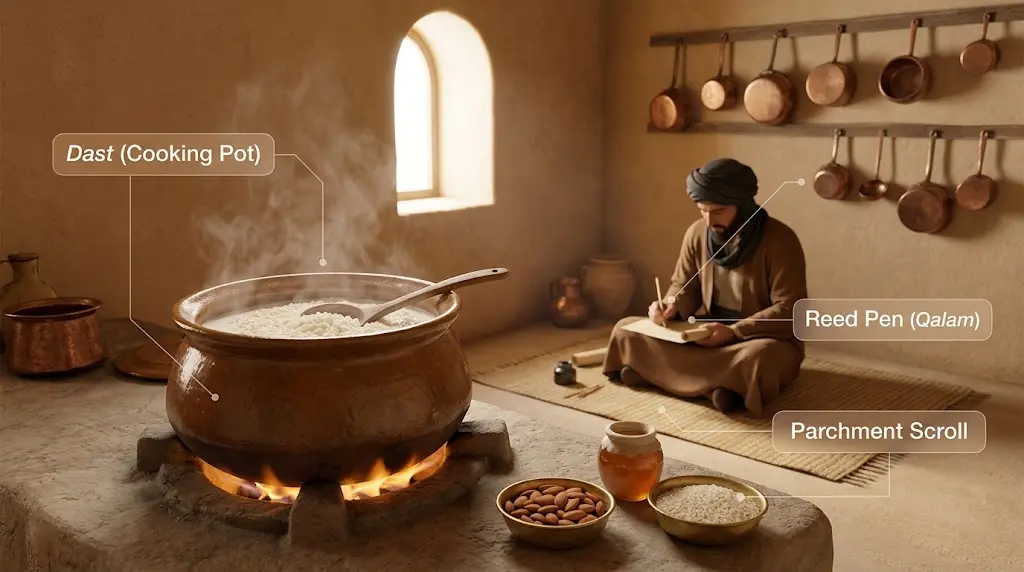
Ibn al-Adim — Kamal al-Din Umar ibn Ahmad ibn al-Adim al-Halabi (1192–1262 CE), a jurist and historian who served as chief judge of Aleppo — wasn’t a professional cook. He was arguably the most important chronicler of Aleppo before the Mongol devastation, author of the encyclopedic Bughyat al-Talab fi Tarikh Halab. But he also compiled a cookbook: Al-Wusla ila al-Habib fi Wasf al-Tayyibat wal-Tayib, critically edited by Suleiman Mahjoub and Duriya al-Khatib and published by the Institute for Arab Scientific Heritage at the University of Aleppo.
On page 79, recipe 5.7, he records the Halabi version under the name al-Ma’muniyya. The verbatim text, as established in the critical edition:
“A sheep’s tail-fat tip is boiled in water until it softens and dissolves. The water is strained away, the fat is pressed through a sieve into a bowl. Rice is washed, pounded, and passed through a fine sieve. Egyptian sugar is ground, and the mixture is placed with the fat in a dast and cooked over a low flame until it sets and holds its consistency. It is spread in the bowl and adorned with whole blanched peeled pistachio hearts.”
Read that slowly. This is not the rice pudding in your refrigerator right now.
The fat in question — taruf al-alya — is the accumulated fat from the tail of the Syrian Awassi sheep. It was, in medieval Levantine cooking, what butter was to northern Europe: the finer cooking fat, the prestige ingredient, the thing you used when the occasion demanded it. The rice is pounded and sieved into flour. Not whole grains. Flour. This gives al-Ma’muniyya a thick, set, almost panna-cotta-like consistency that’s entirely different from the looser, grain-visible pudding most Syrian households make today. The sugar is described specifically as al-sukkar al-Misri — Egyptian sugar — which tells you something about trade routes and what luxury looked like in thirteenth-century Aleppo.
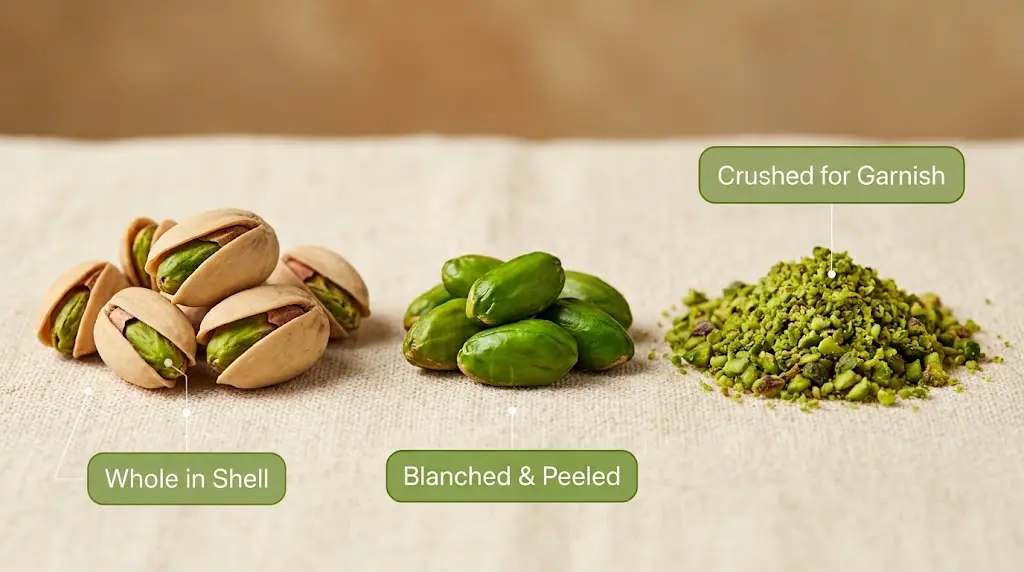
And the pistachio. Qalb fustuq sihah masmut maqshur. Whole, intact, blanched in hot water to loosen the red inner skin, then peeled. The word masmut — from the verb samata, to scald — is still used today in traditional Aleppan pistachio processing. Generations of craft, preserved in a single word.
The Baghdad Recipe and What It Knew About Milk
Ibn al-Warraq’s version is technically more complex — and strangely, more scientifically precise. His instruction that the rice should be soaked in milk “immediately after milking, and in cold weather” is not poetic flourish. It’s chemistry.
Fresh milk contains lipase enzymes that, when activated by heat, produce rancid off-flavors. Cold temperatures slow the lactic acid bacteria that convert lactose into lactic acid — which would begin souring the milk before it ever reached the pot. Someone in the Abbasid court kitchens understood this. They didn’t have the vocabulary for it. They had the knowledge.
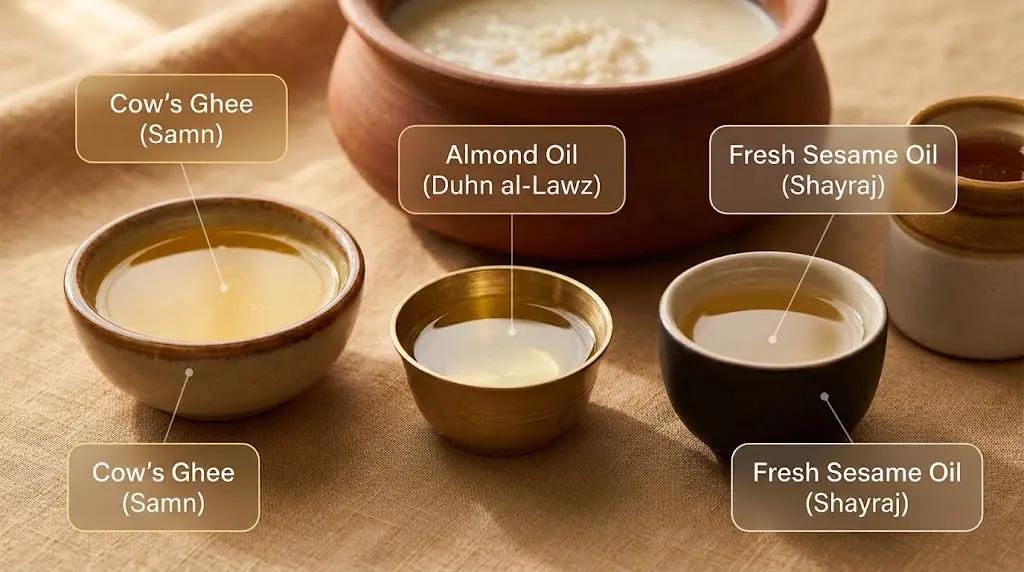
The recipe calls for cooking the rice in water with one of three fats: cow’s ghee (samn al-baqar), almond oil (duhn al-lawz), or fresh sesame oil (shayraj tariyy). The almond oil would have been cold-pressed from fresh sweet almonds. The shayraj — and there’s a legitimate scholarly debate about whether it should be pronounced with an open or closed first vowel, though most Arabic lexicographers from Ibn Manzur’s Lisan al-Arab onward lean toward shayrāj with an open initial — refers specifically to unroasted sesame oil, which is lighter and less intense than the toasted variety used in East Asian cooking.
Honey is added before the rice is fully cooked, so it absorbs. Then milk is added gradually, in stages, until the rice “drinks” it — yashrab al-laban is the original phrase, and it means exactly what it suggests: not liquid remaining in the bowl, but absorbed entirely, the rice swelling with it. The recipe ends with a concession: if you use refined sugar instead of honey, it’s actually better. A thousand years ago, someone’s grandmother was already improvising.
A Dish’s Journey: From Samarra to Aleppo
The name al-Ma’muniyya is attributed to the Caliph al-Ma’mun ibn Harun al-Rashid (786–833 CE), though what Ibn al-Adim documents in Aleppo is a dish that had already been traveling for four centuries by the time he wrote it down. Aleppo in the Ayyubid period wasn’t Baghdad. But it was, in many ways, Baghdad’s most dedicated custodian.
The city passed through Hamdanid, Mirdasid, and Ayyubid rule, each dynasty layering cultural sediment onto what came before. Scholars, judges, poets, and recipes moved along the same roads. Ibn al-Adim himself had studied in Baghdad and Egypt. His cookbook isn’t just a culinary document — it’s a record of what a highly educated thirteenth-century Aleppan thought was worth preserving.
That he included a rice pudding named after an Abbasid caliph suggests the dish had become so thoroughly Aleppan by his time that it no longer needed explanation. It was already home.
What’s worth pausing on — and I find this genuinely striking — is the linguistic archaeology embedded in the vocabulary of these recipes. Dast (the large cooking pot) comes from Persian. Tanjir (another vessel mentioned by Ibn al-Warraq) traces through Aramaic and Syriac before entering Arabic. Yanhari — the verb describing how the fat dissolves completely, still used in Aleppan dialect today when rice is overcooked (el-ruz mahri) — predates the Arab conquests. These aren’t borrowed words. They’re inherited ones. The Abbasid kitchen wasn’t an invention; it was a synthesis of everything that had cooked in this part of the world for centuries before Islam arrived.
The Modern Recipe: What Survived, What Changed, and Why
Here’s what a Syrian home cook needs to make this dish today, and I’ll give you actual quantities because some of us live in the present:
Ingredients (serves 6–8)
- 1 liter whole-fat cow’s milk (or sheep’s milk, if you can find it — the flavor difference is real)
- ½ cup Egyptian short-grain rice, washed and drained
- 1 cup water
- ½ cup fine white sugar (adjust — some families go less, none go more)
- 1 tablespoon orange blossom water (or rose water; this is where families argue)
- 1 tablespoon cornstarch dissolved in ¼ cup cold milk (optional, for a creamier set)
- 2 mastic crystals, ground fine with a pinch of sugar so they don’t clump
- Garnish: crushed or whole Aleppo pistachios, ground cinnamon, optional candied citrus
Method
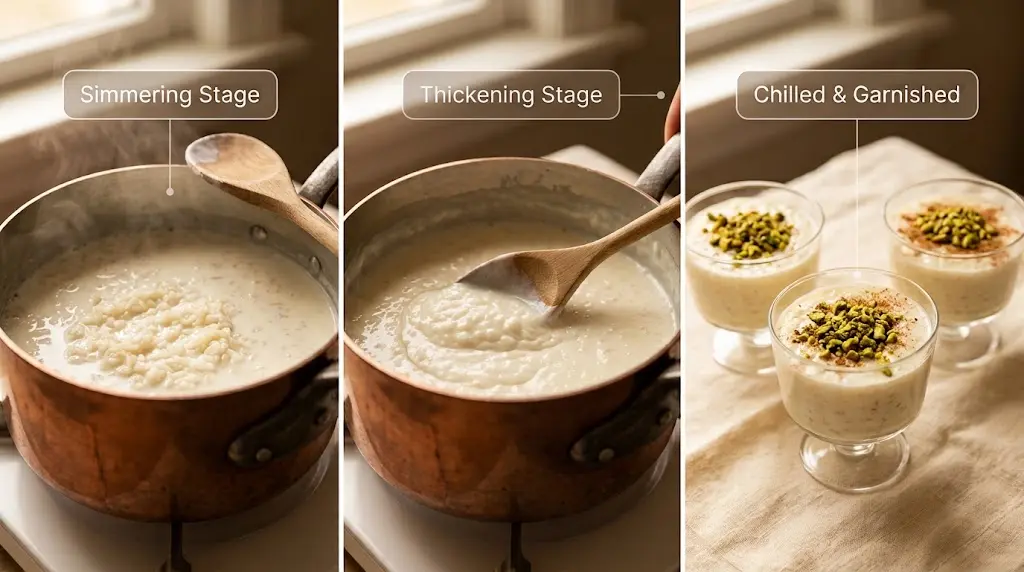
Begin with the rice and water in a heavy-bottomed pot over medium heat. Let it cook until the rice has absorbed most of the water and turned very soft — twelve minutes, roughly, though your stove is not my stove. Add the full liter of milk and reduce the heat to as low as it will go. This part is non-negotiable. Burned milk at the bottom of the pot is not a minor inconvenience; it ruins the entire batch. Stir often, not constantly.
After twenty minutes of gentle simmering — or, more honestly, somewhere between eighteen and twenty-five, depending on the rice variety and how seriously you’re paying attention — add the sugar, the dissolved cornstarch, and the ground mastic. Stir continuously for another five minutes until the mixture thickens and coats the spoon in a way that feels intentional rather than accidental.
Remove from heat entirely before adding the orange blossom water. This matters: the volatile aromatic compounds that give ma’ al-zahar its particular quality will simply cook off if you add it to a hot pot. Off the flame, stir it in quickly, then pour into glass or ceramic serving bowls while still hot. Leave them uncovered at room temperature until they form the thin skin on top — that skin is not a mistake, it’s the point — then refrigerate for at least two hours.
Garnish just before serving. The pistachio goes on cold.
The ratio that produces the distinctly Syrian set — firm enough to hold a spoon’s impression, not liquid at room temperature — is roughly one cup of rice to one and a half liters of milk. Lebanese versions tend to run looser. Neither is wrong, exactly, but they’re different dishes in the ways that matter to people from those places.
What Was Lost in Translation (Literally)
The transformation from the medieval recipe to the contemporary one tracks a series of economic and social shifts that would fill a dissertation. The alya fat disappeared from the recipe as the twentieth century progressed — partly because the Awassi sheep population declined in urban areas, partly because attitudes toward animal fats shifted, partly because the knowledge of how to render and clarify tail fat properly became rarer as fewer households kept livestock.
Almond oil went the same way. Cold-pressing almonds is labor-intensive and expensive; in the Abbasid kitchen it was a prestige ingredient, which is precisely why it’s there. Once cooking fats became industrial commodities — once you could buy a standard block of butter or a bottle of vegetable oil at the corner market — the older fats retreated to specialty use or disappeared entirely.
The shift from pounded rice flour to whole grains is perhaps the most structurally significant change. The original Ma’muniyya was closer in texture to a thick blancmange than to what we call rice pudding. The contemporary Syrian version is texturally a different dish, even if the flavor logic — the sweetened milk, the warmth, the pistachio — is continuous.
What didn’t change: the flower water at the end. The pistachio garnish, documented in a thirteenth-century Aleppo manuscript and still present on every bowl I’ve ever seen served. The insistence on low heat that borders on obsessive in every Syrian kitchen. And the social context — which is perhaps the strangest continuity of all.
| Period / Date | Source & Author | Recipe Reference | Era |
|---|---|---|---|
| 10th Century CE (4th AH) | Kitab al-Tabikh — Ibn Sayyar al-Warraq | Aruzz bi-Laban lil-Wathiq, p. 229 | Abbasid |
| 13th Century CE (7th AH) | Al-Wusla ila al-Habib — Ibn al-Adim al-Halabi | Al-Ma’muniyya, recipe 5.7, p. 79 | Ayyubid |
| 14th Century CE | Kitab Wasf al-At’ima al-Mu’tada — Anonymous | Multiple rice-and-milk preparations | Mamluk |
| 1987 CE | Critical Edition — Kaj Öhrnberg & Sahban Mroueh | Brill / Finnish Oriental Society, Helsinki | Modern |
| 1988 CE | Critical Edition — Suleiman Mahjoub & Duriya al-Khatib | Institute for Arab Scientific Heritage, University of Aleppo | Modern |
| 2022 CE | DGAM Manuscript Damage Report | Directorate-General of Antiquities and Museums, Syria | Contemporary |
The Dish That Shows Up When It Matters
In Syrian households, rice pudding is not a casual dessert. It shows up at specific moments, and this is consistent enough across regions and families that it feels less like custom and more like reflex.
It’s prepared for a woman after she gives birth — the folk belief being that it supports milk production, though the actual reason may simply be that it’s nourishing and easy to eat when you’re exhausted. It appears in the evenings during Ramadan. It’s brought to houses in mourning, where it’s offered to visitors alongside bitter coffee, the sweetness and the bitterness sitting next to each other without resolving.
In northern Syrian villages — Idlib, Aleppo, Hama — it’s made for a child’s Quran completion ceremony. On the Coastal region, it appears on the seventh day after a birth, the sub’u, distributed to neighbors in small glass cups with pistachio on top.
I’ve been told by anthropologists who work in this field — and I think this observation is worth stating plainly — that the recipe functions as a kind of family fingerprint. One household adds mastic, another adds cardamom, a third uses cream (kaymak) instead of milk. A family in Homs might use rose water; a family three streets away insists on orange blossom. These variations aren’t errors or personal quirks. They’re the record of specific women teaching specific daughters across specific decades, each transmission carrying its own slight drift.
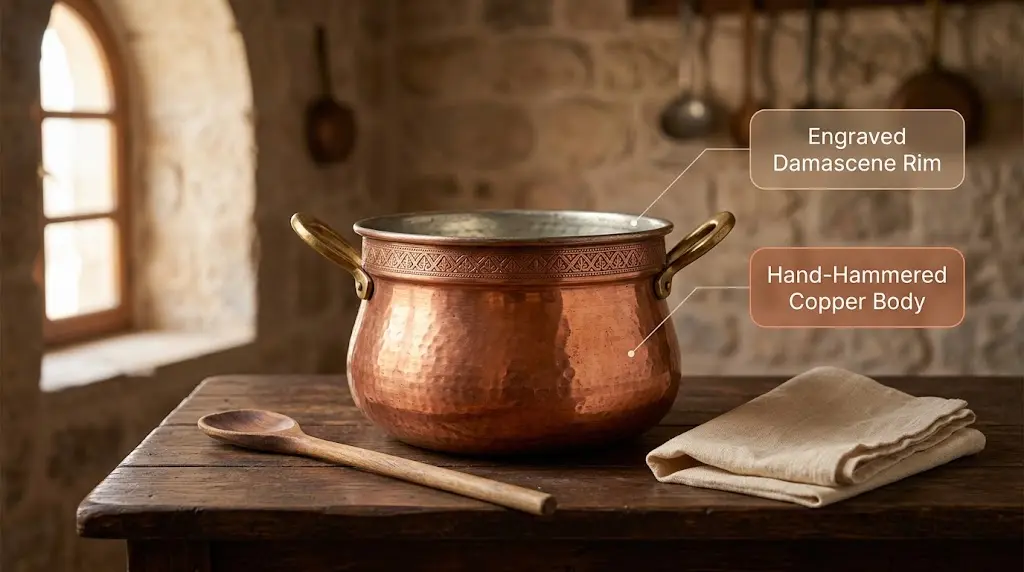
The copper pot used for making rice pudding in traditional Aleppo households was often designated for that purpose alone. Not shared with the savory cooking. Kept differently. This is the kind of detail that doesn’t make it into academic papers but is immediately recognized by anyone who grew up in a Syrian kitchen.
| Syrian Region | Local Name & Signature Ingredient | Distinctive Feature | Cultural Occasion |
|---|---|---|---|
| Aleppo | Ruz bi-Haleeb with mastic and Aleppo pistachio | Thickest set; heaviest pistachio garnish | Quran completion; postpartum |
| Damascus | Ruz bi-Haleeb with orange blossom water (ma’ al-zahar) | Lighter set; strong floral aroma | Ramadan iftar; guest hospitality |
| Homs | Ruz bi-Haleeb with rose water and cinnamon | Rose aroma dominant; darker cinnamon dusting | Mourning gatherings |
| Hama | Ruz bi-Haleeb with clarified butter drizzle | Richer body; distinguished from Hama’s semolina Ma’muniyya | Winter household dessert |
| Syrian Coast | Ruz bi-Haleeb with cream (kaymak) topping | Extra-creamy layer on top; served in small glass cups | Sub’u (seventh day after birth) |
| Hawran | Ruz bi-Haleeb with sheep milk and cardamom | Sheep milk flavor; earthier profile | Harvest celebrations |
| Jazira | Ruz bi-Haleeb with date molasses (dibs) | Amber-brown color; deeper natural sweetness | Winter family gatherings |
The Claims Worth Disputing
Because food history attracts confident misinformation with remarkable consistency, a few specific claims deserve direct response.
The assertion that rice pudding entered the Arab world through French colonial influence in the twentieth century is demonstrably false. The dish appears in full technical detail in a Baghdad manuscript from the tenth century CE. There is no interpretive ambiguity here.
The claim that the Turkish Sütlaç predates the Syrian version is chronologically backward. The Abbasid documentation precedes the earliest Ottoman Sütlaç records by five centuries. The more defensible historical reading is that the dish traveled from the Arab world into the Anatolian kitchen through Mamluk-era networks, not the other direction.
The confusion between Aleppo’s Ma’muniyya and the Hama dish also called Ma’muniyya deserves clarification. The Hama version is made from semolina and clarified butter — a categorically different preparation that happens to share a name. Ibn al-Adim’s thirteenth-century Aleppo document refers specifically to rice, tail fat, and pistachio. There’s no historical evidence that the Hama preparation predates the Aleppo one.
And the pistachio is not a later addition. It’s in the medieval text. It has been in the dish for at least eight centuries. The Aleppo pistachio — Pistacia vera, cultivated in the eastern plains around Mura’k, Khan Tuman, and Ma’arrat al-Nu’man — appears in the garnish instruction by name. This isn’t a decoration that got added somewhere along the way. It’s a structural feature of the dish as it was documented in the city that grew it.
A Note on What’s Being Lost
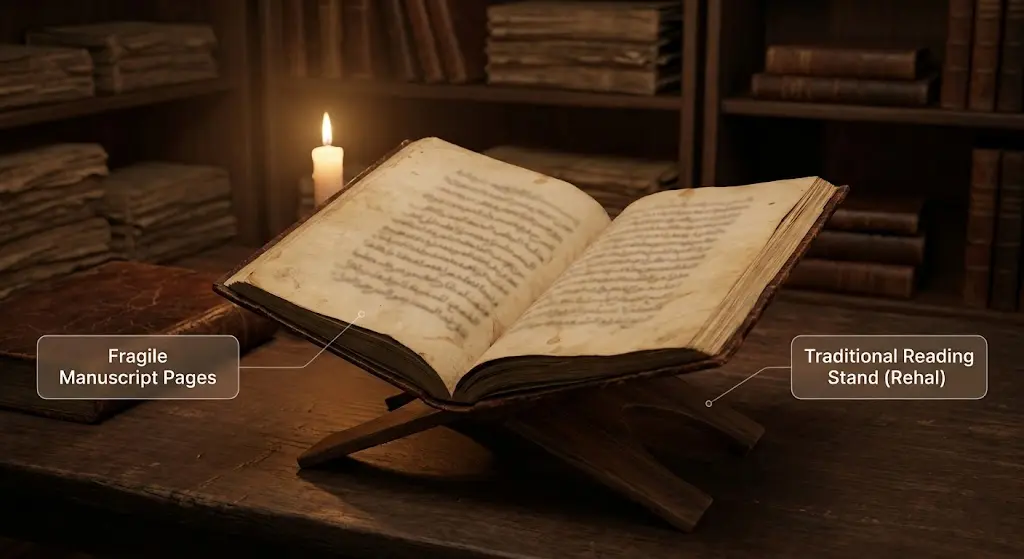
The Kitab al-Tabikh of Ibn al-Warraq sat in European libraries for centuries as an unedited manuscript. The Wusla ila al-Habib of Ibn al-Adim exists in a critical edition published by the University of Aleppo. According to a 2022 report from Syria’s Directorate General of Antiquities and Museums, more than 40% of manuscript collections in Aleppo sustained partial or total damage during the years of conflict.
That number should give anyone pause. The document that proves this recipe is Syrian, that names the pistachio, that records the technique of blanching and peeling — that document is fragile. The copy that Öhrnberg worked from to produce his 1987 Brill edition was in Uppsala. The knowledge survived, this time, partly because it had already traveled.
What hasn’t traveled as well is the oral knowledge: the grandmother who knows by the sound of the boil when to lower the heat, who reads the surface of the pudding for signs of readiness that no written recipe has ever managed to capture, who carries in her hands the accumulated wisdom of the Abbasid court kitchen refracted through seven or eight hundred years of Aleppan domestic life. That knowledge does not have a critical edition. It has no Brill publication date.
The recipe on the page is the easy part. What’s harder to preserve — and what makes that simple white bowl of something sweet and cold actually matter — is everything the page doesn’t say.
| Comparison Aspect | Medieval al-Ma’muniyya (Ibn al-Adim, 13th c.) | Modern Syrian Ruz bi-Haleeb |
|---|---|---|
| Primary Fat | Awassi sheep tail fat (alya) | Whole cow’s milk fat only |
| Rice Form | Pounded and sieved rice flour | Whole short-grain rice |
| Sweetener | Egyptian sugar (al-sukkar al-Misri) | Refined white sugar |
| Texture | Thick, set, panna-cotta-like | Creamy with visible whole grains |
| Cooking Vessel | Dast (large glazed pot) | Heavy-bottomed copper or steel pot |
| Aromatic Finish | None documented | Orange blossom or rose water |
| Pistachio Garnish | Whole blanched peeled Aleppo pistachios | Crushed Aleppo pistachios |
| Serving Vessel | Large communal bowl | Individual glass or ceramic cups |
| Serving Temperature | Warm to room temperature | Chilled |
| Social Context | Court and elite banquets | Household ritual and family occasions |
Primary sources: Ibn al-Warraq, Kitab al-Tabikh, ed. Kaj Öhrnberg and Sahban Mroueh (Helsinki: Finnish Oriental Society, 1987); Ibn al-Adim, Al-Wusla ila al-Habib fi Wasf al-Tayyibat, ed. Suleiman Mahjoub and Duriya al-Khatib (Aleppo: University of Aleppo, Institute for Arab Scientific Heritage). Historical attribution reviewed by Abd al-Hamid Ra’id Hindawi, archaeological and historical reference, Syria Encyclopedia.
Prep time: 10 minutes | Cook time: 35 minutes | Serves: 6–8 | Cuisine: Syrian / Levantine
Encyclopedia of Syria assumes no responsibility for any use that deviates from the educational and documentary purpose of this content, including but not limited to commercial reproduction of recipes or claims of exclusive regional authenticity.
This article draws on the latest official and academic reports and studies:
- UNESCO (2024–2025): Reports on the safeguarding of intangible cultural heritage in the Arab region, including culinary traditions and endangered manuscript collections.
- Directorate-General of Antiquities and Museums of Syria (DGAM, 2022–2025): Official bulletins on manuscript damage in Aleppo and preservation programs for Syrian scholarly heritage.
- French Institute for the Near East (Ifpo): Specialized studies in Syrian medieval history, food anthropology, and the manuscript tradition of Ibn al-Adim.
- International Council on Monuments and Sites (ICOMOS): International standards for the protection of intangible heritage and traditional knowledge systems.
- Brill Academic Publishers & Finnish Oriental Society: Critical edition of Ibn al-Warraq’s Kitab al-Tabikh (Öhrnberg & Mroueh, 1987).
- University of Aleppo — Institute for Arab Scientific Heritage: Critical edition of Ibn al-Adim’s Al-Wusla ila al-Habib fi Wasf al-Tayyibat wal-Tayib (Mahjoub & al-Khatib).
- Leading international universities specializing in Near Eastern studies: University of Chicago, University of Tübingen, Sorbonne University.
Dr. Nadeem Omar Al-Atassi — Syrian Heritage & Linguistics Expert
Archaeologist Abdul Hamid Raed Hindawi — Historical Reviewer