
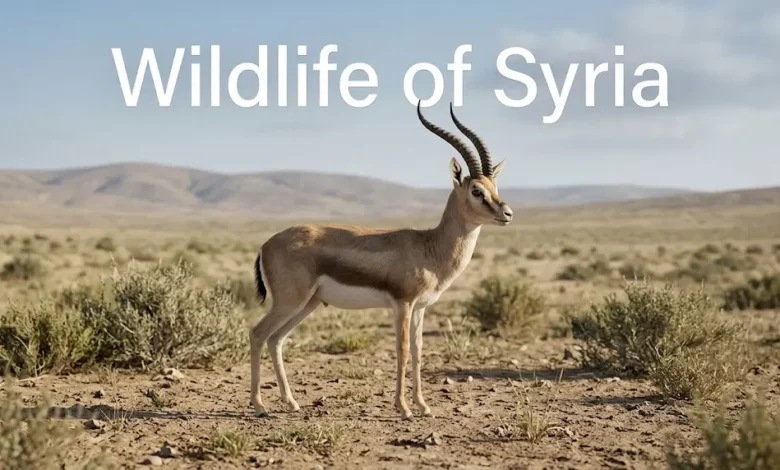
Wildlife in Syria reflects the country’s varied landscapes, from the wooded coastal mountains and agricultural plains to the dry steppe, river valleys, wetlands, and Mediterranean coast. Specialist checklists document 110 wild mammal species, 415 bird species in a 2025 annotated checklist, 108 confirmed freshwater fish species in a 2023 revision, and 303 marine bony fish species in a 2025 checklist. These figures cover different animal groups and use different methods; they are not a single count of all wildlife in Syria.
The records also differ in date and reliability. Some species live or breed in Syria year-round, while others migrate through the country, appear only occasionally, or are known from historical records. A species’ global conservation status does not, by itself, reveal the size or condition of its population in Syria.
Core findings
- Use the published checklists as species catalogues, not as counts of individual animals.
- Keep group totals separate: 110 mammals, 415 birds in the 2025 annotated list, 108 freshwater fishes and 303 marine bony fishes are based on different scopes and dates.
Key places and dates
- Recent goitered-gazelle records cited in the checklist are from 2019–2021 near Jabal Abd al-Aziz.
- Sabkhat al-Jabbul’s Ramsar area, historical maximum water surface and Key Biodiversity Area polygon are separate measurements from different years.
How to read the evidence
- Global Red List status does not establish a Syrian population trend.
- The Palmyra northern bald ibis breeding population is described as probably gone; that is not the same as saying the species is extinct worldwide.
Understanding Syria’s Wildlife
What Does “Wildlife of Syria” Include?
Wild mammals, birds, reptiles, amphibians, fishes and invertebrates belong in the subject. Domestic sheep, goats and cattle do not, except where grazing, water use or predation links them to wild species. The 2025 mammal checklist also marks animals that now live free but are not part of the older fauna: the coypu, Myocastor coypus, and the brown and black rats, Rattus norvegicus and Rattus rattus, are flagged as introduced.
The mammal total is unusually explicit. Aidek and colleagues, writing in Zootaxa on 30 January 2025, compiled literature, grey records, photographs and field surveys from 2006 to 2023. Their 110 species fall into seven orders, 36 families and 73 genera, and include 15 species that are globally threatened. The composition is one hyrax, two hares, 36 rodents, eight insectivores, 27 bats, 20 carnivores, seven terrestrial even-toed ungulates and nine cetaceans.
Dividing those published counts by 110 shows where the diversity actually sits. Rodents are 32.7 percent, bats 24.5 percent, and insectivores 7.3 percent. Together those three groups are 71 species, or 64.5 percent of the wild mammal list. Carnivores are 18.2 percent and the seven terrestrial ungulates only 6.4 percent. Cetaceans account for the remaining 8.2 percent. This is a statement about the checklist, not about how many individuals exist. A rare bat and a widespread fox each count as one species.
Two recent sources give different totals for Syria’s birds. The 2025 annotated checklist records 415 species, adding 21 species to the previous list and confirming breeding for 16 species for the first time. BirdLife International’s country dataset lists 350 species. These totals should be treated as separate datasets because their taxonomic and record-inclusion criteria differ.
| Wildlife group | Published total | Publication and evidence period | Scope note |
|---|---|---|---|
| Wild mammals | 110 species | 2025 checklist; literature and surveys, 2006–2023 | A species checklist, not an individual-animal census |
| Birds | 415 species | Annotated checklist published in 2025 | BirdLife lists 350 under different taxonomic and geographic filters |
| Chelonians | 9 species | 2024 review; fieldwork from 2019–2023 | 321 distribution records; not a population count |
| Amphibians | 8 species | 2025 review; fieldwork from 2019–2023 | Records and localities do not measure population size |
| Freshwater fishes | 108 species | Revised checklist published in 2023 | 17 previously reported species were excluded |
| Marine bony fishes | 303 teleost species | Updated checklist published in 2025 | Sharks and rays are outside this teleost total |
These figures describe different taxonomic groups and checklist rules. They should not be added into a single national species total or read as estimates of animal abundance.
Why Is Syria’s Geographic Location Important for Wildlife?
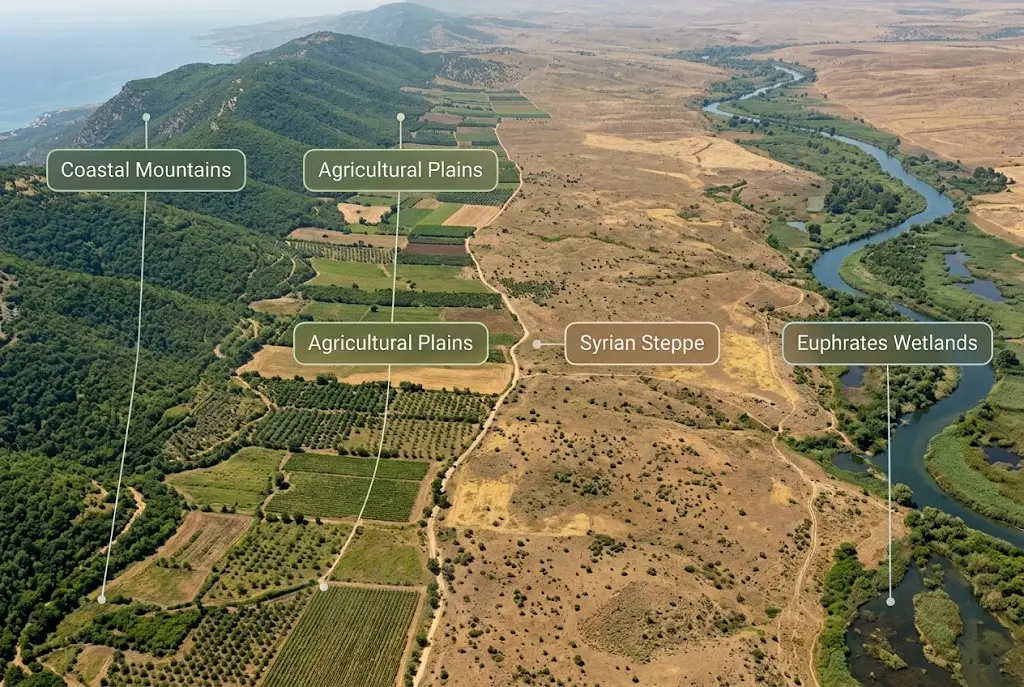
Syria’s coastal mountains, agricultural plains, steppe, semi-desert, rivers, and wetlands differ in rainfall, vegetation, and water availability. These differences support distinct wildlife communities. A species recorded in one region should not automatically be assumed to occur throughout the country.
In the Fronloq–Kasab area of the coastal mountains, a botanical assessment reports annual rainfall above 1,100 millimetres. Farther inland, vegetation becomes sparser and more drought-adapted. Forest mammals, steppe gazelles, and wetland birds therefore occupy very different habitats. Seasonal migration adds another dimension, as some birds use Syria only while moving between breeding and wintering grounds.
Major Wildlife Habitats in Syria
A geographic orientation graphic based on the article’s habitat descriptions; the shaded zones are generalized.
- Coastal mountains
- Agricultural plains
- Steppe and semi-desert
- Rivers, lakes and wetlands
- Mediterranean marine area
Scientific scope note: Habitat zones, river courses and wetland locations are generalized for orientation, not mapped survey boundaries. No animal distribution is asserted or shown. The graphic is not for navigation or legal boundary use.
Coastal Mountains and Mediterranean Woodlands
The coastal mountains, including the Fronloq protected area in Latakia governorate and forest areas such as Abu Qubays, are the humid end of the Syrian map. A bird study there covered 5,390 hectares and recorded 67 species by point counts. Raptors made up 16.41 percent of those species, and 24 species were breeding. Oak habitat held more species and more individuals than pine or burned sites, and bird richness rose with plant richness and shrub cover. The study is local, but the mechanism is general: on these slopes, animal distribution tracks vegetation structure, rainfall and fire history, not the reserve boundary alone.
The Caucasian squirrel, Sciurus anomalus, belongs to this wooded mountain fauna and is listed as Least Concern in the mammal checklist. Amphibians, too, have more habitat here and along permanent water than they do in the open steppe. Abu Qubays has been identified as an important plant area because of rare and threatened plants; that botanical designation is not a mammal survey, but it marks the same environmental break between the wet crest and the drier inland slope.
Agricultural Plains and Open Landscapes
Cultivated land is wildlife habitat of a particular kind. The red fox, Vulpes vulpes, is the clearest documented example. The 2025 checklist describes it as widespread in dry open country, woodland, riverside vegetation, short grassland and steppe, with records from the coastal mountains, Palmyra, the Euphrates valley, Idlib, Salamiyah, the Ghouta of Damascus and Jabal Abd al-Aziz. The golden jackal, Canis aureus, also uses farmland edges. Species with those habits can persist, and sometimes increase, where specialist steppe or forest animals lose ground.
The exchange cuts both ways. Foxes and jackals take rodents and scavenge around livestock. Grazing and cultivation simplify plant cover and can displace animals that need continuous shrub or permanent marsh. The Ghab, the former wetland of the Orontes valley, is a documented case of the second process: a botanical assessment describes the depression as converted to intensive agriculture by a large drainage scheme, with only remnant patches of the original vegetation. Those remnants, not the drained plain as a whole, are what remain available to amphibians and wetland birds.
The Syrian Steppe and Semi-Desert
Most of inland Syria is steppe or semi-desert. Plant cover is often a scatter of drought shrubs; the bird checklist’s landscape description includes Anabasis, Salsola, Artemisia and Haloxylon. Animals that persist here move with forage and water rather than with a fixed territory in the temperate sense.
The goitered gazelle, Gazella subgutturosa, shows how narrow that persistence can be. The 2025 treatment places it in a limited belt of arid plains and steppe near Jabal Abd al-Aziz and in Mesopotamia, cites older records from Raqqa, Tell Abyad and Ras al-Ayn, and reports recent records from the southwestern steppes of Jabal Abd al-Aziz in 2019–2021. Its global category in that checklist is Vulnerable. It is not a generic “gazelle of the Badia,” and the Arabic name reem is a poor guide, because it has been applied to more than one species.
Jabal Abd al-Aziz itself, an elongated range in the Jazira between arid and semi-arid conditions, also appears as an important plant area and, in older BirdLife assessments, as a site for birds. One mountain can matter to gazelles, plants and birds for different reasons.
Rivers, Lakes, and Wetlands
The Euphrates and its tributary the Khabur, Lake Assad behind the Euphrates Dam, the Orontes, and Lake Qattinah near Homs are not one freshwater system. Lake Assad is a reservoir. It can hold fish and attract waterbirds, and BirdLife lists it as an Important Bird Area, but a dammed reach is not the river that preceded it. Barriers, still water and changed flows rearrange fish communities.
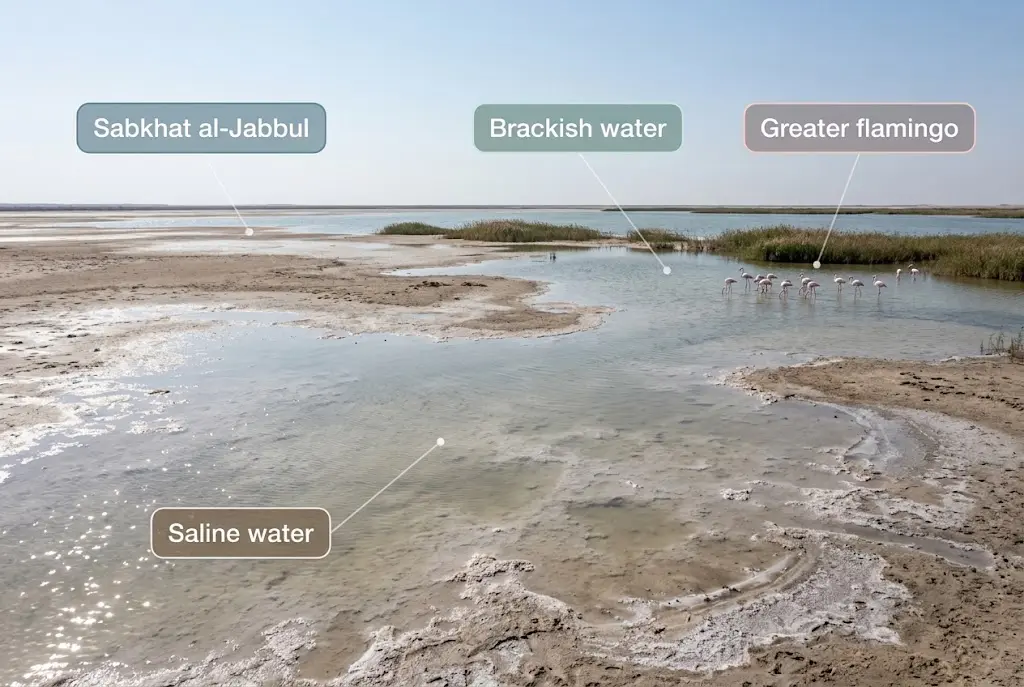
Sabkhat al-Jabbul, a saline depression southeast of Aleppo, is the wetland for which the paper trail is strongest, provided the numbers are kept apart. It was designated Ramsar site 935 on 5 March 1998, with a listed area of 10,000 hectares. The information sheet, last updated in 1997, describes a permanent saline lake important for staging, wintering and breeding waterbirds, and notes that it regularly supported more than 1 percent of the global population of the greater flamingo, Phoenicopterus roseus.
A 2006 study led by Gianluca Serra described a different physical system from the seasonal salt lake of earlier accounts. Dikes and irrigation drainage had produced three water bodies, from saline to brackish, with a maximum water surface then given as 270 square kilometres, and with reedbeds on some shores. A later Key Biodiversity Area polygon for the site is about 418 square kilometres, from an assessment in 2016. The legal site, the water surface in a wet period, and the biodiversity polygon are three measurements. Treating them as rival figures for “the size of the lake” is the error.
| Measurement | Reported figure | Date or source period | What it represents |
|---|---|---|---|
| Ramsar site listed area | 10,000 ha | Site designated in 1998; information sheet updated in 1997 | Listed Ramsar site area |
| Maximum water surface reported | 270 km² | Serra et al., 2006 | Water surface described in that study, not a current measurement |
| Key Biodiversity Area polygon | About 418 km² | Assessment in 2016 | A biodiversity-site polygon, not the lake’s water surface |
The figures refer to different dates, boundaries and kinds of measurement. Do not merge them into a single current “lake size.”
The Syrian Mediterranean Coast
The Syrian coastline is short beside the steppe, but the water in front of it is a separate fauna. Marine bony fishes are not an extension of the Orontes. Ibrahim and colleagues, in a 2025 checklist limited to teleosts, recorded 303 species in 208 genera and 103 families, representing 37 of the 62 bony-fish orders known from the world’s oceans. Seabreams (Sparidae) contributed 32 species, blennies 14 and jacks 13. Sharks and rays are outside that total.
Coastal wildlife also includes the two marine turtle species that a 2024 review found using Syrian beaches for nesting, and the whales, dolphins and monk seals discussed below. Fishing, pollution, coastal construction and species arriving through the Suez Canal are the pressures named in the regional literature. Which of them has changed which population is a separate, and often unanswered, question.
| Habitat | Representative documented animals or groups | Evidence cited in the article | Pressures or changes mentioned | What the evidence does not establish |
|---|---|---|---|---|
| Coastal mountains and Mediterranean woodlands | Woodland birds, including raptors; Caucasian squirrel is listed in the mammal checklist. | The Fronloq study recorded 67 bird species across 5,390 ha; raptors made up 16.41% of the recorded species, and 24 species were recorded as breeding. Source refs. 1, 13 | In the Fronloq study, oak habitat had greater bird richness and abundance than pine or burned sites. The article also discusses habitat loss and fragmentation. | A local forest study is not a national bird total or a measure of the current condition of every coastal forest. |
| Agricultural plains and open landscapes | Red fox and golden jackal; both are described in relation to open or agricultural landscapes. | The red fox is recorded across several habitat types, including farmland and steppe; the golden jackal uses farmland edges. The Ghab is described as converted to intensive agriculture, with remnants of former vegetation. Source refs. 1, 14–15 | Intensive cultivation and wetland drainage are documented changes in the Ghab; land conversion can reduce or alter remnant habitat. | These records do not show that every agricultural plain has the same species or the same level of habitat change. |
| Syrian Steppe and semi-desert | Goitered gazelle and red fox are among the documented mammals associated with steppe or open arid habitats. | The checklist cites goitered-gazelle records near Jabal Abd al-Aziz from 2019–2021. The red fox is described in dry open country and steppe. Source ref. 1 | The article discusses overgrazing, illegal hunting, habitat fragmentation and water scarcity as pressures affecting wildlife habitats. | A dated sighting confirms presence at a place and time; it is not a population estimate or a national trend. |
| Rivers, lakes and wetlands | Freshwater fishes; greater flamingos and ducks recorded at Sabkhat al-Jabbul. | The 2023 freshwater checklist recognizes 108 species. Jabbul bird counts cited in the article are historical and include a February 2009 flamingo peak of 21,056. Source refs. 7, 16–18 | The cited studies discuss drainage, irrigation drainage, pollution, salinity changes, hunting and shoreline vegetation damage at Jabbul; dams and water extraction are also discussed for freshwater systems. | The Jabbul counts are not a current winter census; the freshwater checklist is not a new 2026 resurvey. |
| Syrian Mediterranean coast and marine waters | Marine teleost fishes, nesting marine turtles, cetaceans and the Mediterranean monk seal. | The marine checklist records 303 teleost species; a turtle review reports two marine species nesting on Syrian beaches. Marine-mammal documentation includes stranding records. Source refs. 4, 9–12 | The marine literature discusses fishing, pollution, coastal construction and introduced species; the article does not assign a measured population decline to each pressure. | Checklist totals are not animal counts; a stranding record does not by itself demonstrate a resident marine-mammal population. |
Scientific scope note: Pressures are reported as documented changes or concerns, not ranked by national severity. Species examples are linked to the cited evidence and are not claims that each species occurs throughout the full habitat.
Mammals of Syria
Wild Ungulates and Grazing Mammals
The 2025 checklist recognizes seven terrestrial even-toed ungulates: the Dorcas gazelle (Gazella dorcas), mountain gazelle (Gazella gazella), Arabian sand gazelle (Gazella marica), goitered gazelle (Gazella subgutturosa), Nubian ibex (Capra nubiana), western roe deer (Capreolus capreolus), and wild boar (Sus scrofa).
The checklist records the mountain gazelle (Gazella gazella) as globally Endangered, while the Arabian sand gazelle (Gazella marica), goitered gazelle (Gazella subgutturosa), and Dorcas gazelle (Gazella dorcas) are listed as Vulnerable. These categories reflect the assessments adopted by the checklist, which cites IUCN assessments from 2023. They do not provide estimates of population size within Syria.
The distinction between sand gazelle and goitered gazelle also matters when reading older Syrian records. At Al-Talila, near Palmyra, the sand gazelle was managed under the then-used subspecies name Gazella subgutturosa marica. The 2025 checklist treats Gazella marica as a separate species. Taxonomic revisions can therefore change a national species list even when no change in the animals themselves has occurred.
The Nubian ibex, Capra nubiana, also Vulnerable, is a lesson in geographic caution. The checklist confines the current record to the Golan Heights. Earlier reports include animals from Jabal al-Abtar, southwest of Palmyra, in 1930, and a specimen from east of al-Qaryatayn. Reports from the eastern mountains north of Damascus are described as unsubstantiated. The species account says the ibex might have disappeared from Syria by the end of the 1950s, and that it was reintroduced to the Golan Heights in 1970, after being separated from the Alpine ibex as a full species. “Might” is part of the evidence.
Western roe deer, Capreolus capreolus, is listed as Least Concern. That global category is not a map of Syrian woodlands, and no national population figure is given in the sources used here. Wild boar occupies the opposite end of human contact, using thickets, riverine cover and agricultural edges, but again the checklist records the species rather than its numbers.
Carnivores and Wild Predators
Twenty carnivores is not twenty large predators. The systematic table includes the grey wolf, Canis lupus (with the subspecies pallipes and arabs), the golden jackal, the red fox, Rüppell’s fox, Vulpes rueppellii, the caracal, Caracal caracal, the brown bear, Ursus arctos syriacus, and the Mediterranean monk seal, Monachus monachus. Wolf, jackal, both foxes and caracal are listed as Least Concern. The checklist lists the brown bear entry as Vulnerable and the Mediterranean monk seal as Endangered. These classifications should be reported as given by the source and should not be interpreted as estimates of their populations within Syria. Small cats of the genus Felis are also present in the table. Lion, leopard and cheetah are not part of this living list of 110, and this account does not convert that absence into a dated extinction history.
The striped hyena, Hyaena hyaena, is in the checklist, which includes a map of its records, and is globally Near Threatened. It is both a predator and a scavenger. An investigative report published in September 2026 documented killings in Deir ez-Zor, rural Damascus, Idlib and northern Aleppo, including carcasses displayed on social media and trade in skin, bone and teeth, sometimes justified by livestock complaints and sometimes by folk-medical beliefs. Those cases show a real pressure. They are not a national mortality rate, and they do not move the global category by themselves.
No source used here estimates how many wolves, bears or hyenas remain in Syria. Global Least Concern, in particular, can sit beside a thin and poorly counted local population.
Small Mammals: Rodents, Hedgehogs, and Shrews
Thirty-six rodents make the soil fauna hard to dismiss as a footnote. The list includes jerboas, jirds, gerbils, mice and mole-rats, among them the Syrian brush-tailed mouse, Calomyscus tsolovi, and the Middle East blind mole-rat, Nannospalax ehrenbergi, both placed in Data Deficient. Data Deficient is an admission of ignorance, not a finding that the animal is safe or rare.
The golden hamster, Mesocricetus auratus, is the small mammal with the largest reputation and one of the more serious listings: Endangered in the same checklist. Its scientific history is tied to the country around Aleppo, and its worldwide use in laboratories says nothing about the security of the wild population. Iranian vole, Microtus irani, is listed as Vulnerable.
Three hedgehogs open that part of the table: the southern white-breasted hedgehog, Erinaceus concolor, the long-eared hedgehog, Hemiechinus auritus, and a desert hedgehog in the genus Paraechinus. Two hares, the Cape hare and the European hare, are both Least Concern. The rock hyrax, Procavia capensis syriaca, is the country’s only hyrax. It is not a rodent, despite the resemblance a distant look suggests. These animals are prey, seed consumers, burrowers and insect predators; several larger carnivores exist, in any practical sense, because they do.
Bats and Cave-Dwelling Mammals
Twenty-seven bat species, almost a quarter of the mammal fauna, reflect taxonomic attention as well as caves. Bats roost in caves, rock fissures and old buildings and feed where insects gather over water and fields. They are easy to omit from a daylight account of “Syrian animals” and difficult to protect accidentally: sealing a cave, or broadcasting insecticides, reaches them whether or not a management plan mentions them.
Marine Mammals Recorded in Syrian Waters
Syrian waters are among the least studied parts of the Mediterranean for whales and dolphins. In a chapter published through IntechOpen, Adib Saad and Ilene Mahfoud describe shoreline monitoring of stranded animals since 2002 and report 11 marine-mammal species living in or visiting those waters: ten cetaceans and one seal. The names include the common bottlenose dolphin, Tursiops truncatus, striped dolphin, Stenella coeruleoalba, short-beaked common dolphin, Delphinus delphis, Risso’s dolphin, Grampus griseus, false killer whale, Pseudorca crassidens, sperm whale, Physeter macrocephalus, Cuvier’s beaked whale, Ziphius cavirostris, fin whale, Balaenoptera physalus, minke whale, Balaenoptera acutorostrata, and humpback whale, Megaptera novaeangliae, together with the Mediterranean monk seal.
A stranded animal proves that the species reached Syrian waters. It does not prove a resident population, local breeding, or regular occurrence. The 2025 mammal checklist counts nine cetaceans rather than ten. The difference may be a stricter standard of confirmation or a later taxonomic decision; the larger number should not automatically win.
Threatened and Declining Mammals
“Fifteen globally threatened wild mammals” is the checklist’s phrase. It is not a list of fifteen national extinctions. Mountain gazelle, golden hamster and monk seal are Endangered at global level; sand gazelle, goitered gazelle, Nubian ibex and brown bear are Vulnerable; several other species on the wider list carry other categories, including Near Threatened and Data Deficient. A species can be globally threatened and still have a recent Syrian record, as the goitered gazelle does near Jabal Abd al-Aziz. It can also be globally Least Concern, as the wolf is, while its Syrian numbers remain unknown. Local decline, global threat and local extinction answer different questions.
Birds of Syria
Resident Birds and Breeding Species
Resident and breeding birds are those for which Syria provides enough cover, food and nest sites to complete a season, not merely a stop. The 194 breeding species in the 2025 checklist include both year-round residents and summer visitors, and they are not spread evenly across the country. The Fronloq counts make that concrete at the scale of one reserve: 67 species in one forest complex, with a measurable difference between oak, pine and burned ground.
Some additions to the national list are recent enough to need interpretation. The Arabian green bee-eater, Merops cyanophrys, and the Indian roller, Coracias benghalensis, are among the species highlighted when the 2025 checklist was announced. A first country record can mean a real range expansion, better observation, or a taxonomic split. The record alone does not choose among those explanations.
Migratory Birds and Seasonal Movements
Syria lies on the broad passage between Eurasia and Africa. BirdLife’s country file treats 291 species as migratory and identifies 18 of its 22 important sites specifically for migrant birds. Spring and autumn passage depend on food, water and safe resting ground. The Euphrates valley, Lake Assad, Lake Qattinah, Sabkhat al-Jabbul, the Palmyra desert and the coastal site of Umm al-Tuyour do not offer the same kind of stop. A salt lake, a reservoir, a river corridor and a desert staging area solve different problems for different birds.
Many of BirdLife’s site assessments for Syria date from 1994, with the Tadmur desert and mountains updated in 2007. A site can remain geographically important after its bird counts have gone stale. Using a 1994 assessment as a 2026 census is the mistake the dates are there to prevent.
Waterbirds and Wetland Species
At Sabkhat al-Jabbul, the 2006 study concluded that the wetland then held more than 1 percent of the world population of several waterbirds, including greater flamingo, the globally threatened white-headed duck, Oxyura leucocephala, marbled duck, Marmaronetta angustirostris, and ferruginous duck, Aythya nyroca. Counts cited in that body of work include about 725 white-headed ducks on 25 January 2005 and more than 380 on 9 December 2005. Greater flamingo numbers reached the order of 10,000–15,000 birds in winter 2004 and spring 2005. Breeding was confirmed in May 2006, at roughly 500 pairs, the first such Syrian record reported by those observers.
A year-round flamingo survey from June 2008 to June 2009 found a February peak of 21,056 birds, an October low of 4,350, and up to about 4,000 nesting pairs in May 2009, with some nest loss when water rose. These are strong historical counts. They are not a description of the most recent winter, and no later census of the same design was available for this article.
Birds of Prey and Scavengers
Raptors occur from the coastal forests to the steppe edge. At Fronloq they were a substantial share of a forest bird community, including breeding records for species such as European honey-buzzard and Eurasian sparrowhawk. At Jabbul, the 2006 wetland paper listed pallid harrier and greater spotted eagle among the birds of conservation concern then using the site. Vultures and other scavengers, where still present, remove carcasses, as striped hyenas do on the ground. Persecution aimed at “harmful” birds hits that function. Each species still needs its own record: a harrier on passage, a breeding woodland accipiter and a scavenging vulture are not one conservation case.
Important Bird Areas and Wetland Sites
BirdLife lists 22 Important Bird and Biodiversity Areas in Syria, with a combined area stated as 13,634 square kilometres. The network includes Mount Hermon, Ras al-Ayn, Jabal Abd al-Aziz, Sabkhat al-Jabbul, Lake Assad, Baath Lake, Umm al-Tuyour, the Euphrates valley, Jabal Slenfeh, Jabal al-Bishri, Jabal al-Bilas, Lake Qattinah (listed as Bahrat Homs), the Tadmur desert and mountains, and the Yarmouk valley. The same factsheet displays an average protected-area coverage of 0 percent for these sites. That figure is an output of the global protected-area database overlaid on the site layer. It does not, by itself, prove that no Syrian reserve exists. It does show a gap between documented importance, national designation and what the global layer currently recognizes.
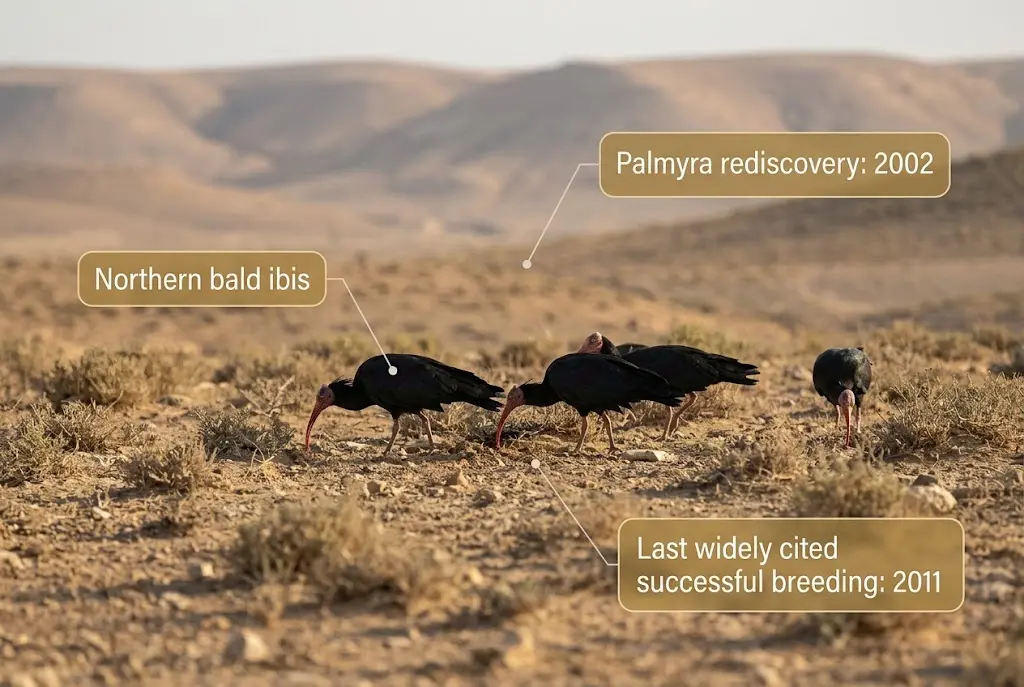
The northern bald ibis, Geronticus eremita, made the Palmyra steppe internationally visible in April 2002, when a colony of seven birds was found, long after the eastern population had been treated as gone. Over the 2002–2007 seasons, two or three pairs fledged 24 young. The last successful breeding widely cited is 2011, when one pair fledged two young. The IUCN account concludes that the Syrian population is probably extinct as a breeding population. Searches of the wider steppe in 2003 found no other colony. A March 2025 analysis judged the eastern migratory population functionally extinct, while leaving a narrow possibility that an undetected colony survives elsewhere in the region. That possibility is not evidence of survival. Globally, the species is Endangered, a category driven by the Moroccan population, not by the Syrian colony.
Threatened and Rare Birds
BirdLife’s 19 globally threatened species on the Syria list cover very different relationships with the country. White-headed duck is a wetland bird with historical concentrations at Jabbul. Asian houbara, Chlamydotis macqueenii, and great bustard are birds of open and steppe country. Sociable lapwing, Vanellus gregarius, is Critically Endangered globally and occurs as a passage species, not as a Syrian breeding endemic. Being on the country list means the species has been recorded under that authority’s rules. It does not mean the bird nests in Syria, or that the Syrian trend matches the global one.
Reptiles and Amphibians of Syria
Tortoises and Freshwater Turtles
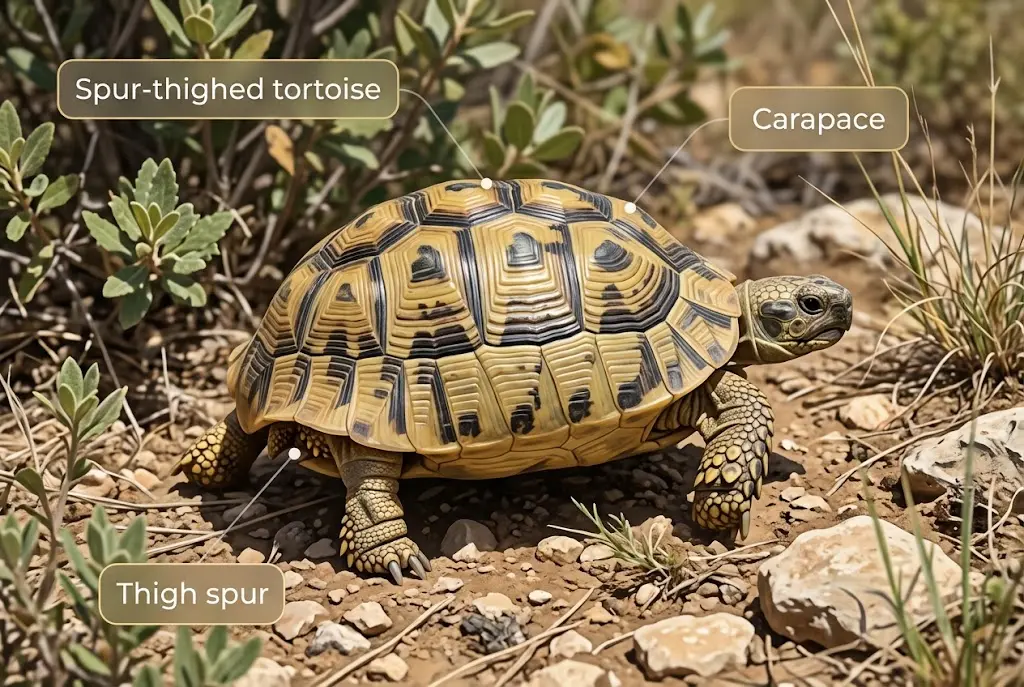
Syria has nine species of chelonians in six families, a family-level spread that is notable for the eastern Mediterranean because it includes land tortoises, freshwater turtles and sea turtles. A 2024 review by Aidek, Saad, Jablonski, Esterbauer and Fritz combined literature, databases, museum material and fieldwork from 2019 to 2023. It assembled 321 distribution records, 105 of them new, and rechecked 18 previously published sites. The most frequently recorded form was the spur-thighed tortoise, Testudo graeca terrestris. A land tortoise needs forage, cover and soils where nests are not crushed. A freshwater turtle needs permanent or seasonal water of the right quality. Protecting one does not protect the other.
Sea Turtles Along the Syrian Coast
The same 2024 review is the first to evaluate systematically the records of two marine turtle species that use the Syrian coast for nesting. The abstract does not name them, so this article does not supply names the source withheld. Nesting adds a terrestrial requirement, a usable beach, to a marine life. Artificial light, vehicles, disturbance and fisheries are the familiar mechanisms of harm in the Mediterranean; their relative weight on the Syrian coast is not measured in the sources used here.
Lizards and Geckos
Lizards and geckos occupy rock, walls, dry ground and the edges of cultivation. Some are nocturnal, some are climbers, and some are sand specialists. The sources reviewed here do not provide a recent national checklist for lizards and geckos comparable in scope to the 2024 chelonian review. That is a gap in documentation, not a finding that the animals are few. Shared Arabic or English names such as “gecko” cover several genera, so a distribution claim needs a scientific name.
Snakes and Vipers
Snakes occur from humid margins to steppe and take rodents and other small vertebrates. The difference between venomous and non-venomous species is real and can be made only from a reliable identification, not from a triangular head in a second-hand description. Indiscriminate killing hits both groups. No national total for that mortality is available here, and this account does not publish a list of “dangerous snakes of Syria” in the absence of a modern species-by-species review.
Frogs, Toads, and Other Amphibians
Eight amphibian species in five families is a small number beside the bird list, and the climate explains it. Most of Syria is dry, and an amphibian needs fresh water for part of its life. The 2025 review by Aidek, Jablonski, Dufresnes, Salimeh and Omran compiled 199 published records from 118 localities and added 145 records from 113 localities during fieldwork in 2019–2023. The 2025 review by Aidek, Jablonski, Dufresnes, Salimeh and Omran compiled 199 previously published records from 118 localities and added 145 records from 113 localities during fieldwork in 2019–2023. The expanded dataset improves knowledge of the distribution of amphibians in Syria, but occurrence records do not measure population size. Pollution, wetland drainage, and the loss of springs can threaten amphibians by reducing the availability and quality of their breeding habitats.
Conservation Challenges for Reptiles and Amphibians
Habitat loss, road mortality, direct killing, pollution and disappearing water are not one threat. Draining the Ghab matters more to an amphibian than to a desert gecko. Beach traffic matters more to a nesting sea turtle than to a steppe tortoise. Data are best for turtles, improving for amphibians, and still thin for lizards and snakes.
Freshwater and Marine Fish in Syria
Freshwater Fish of Syrian Rivers and Lakes
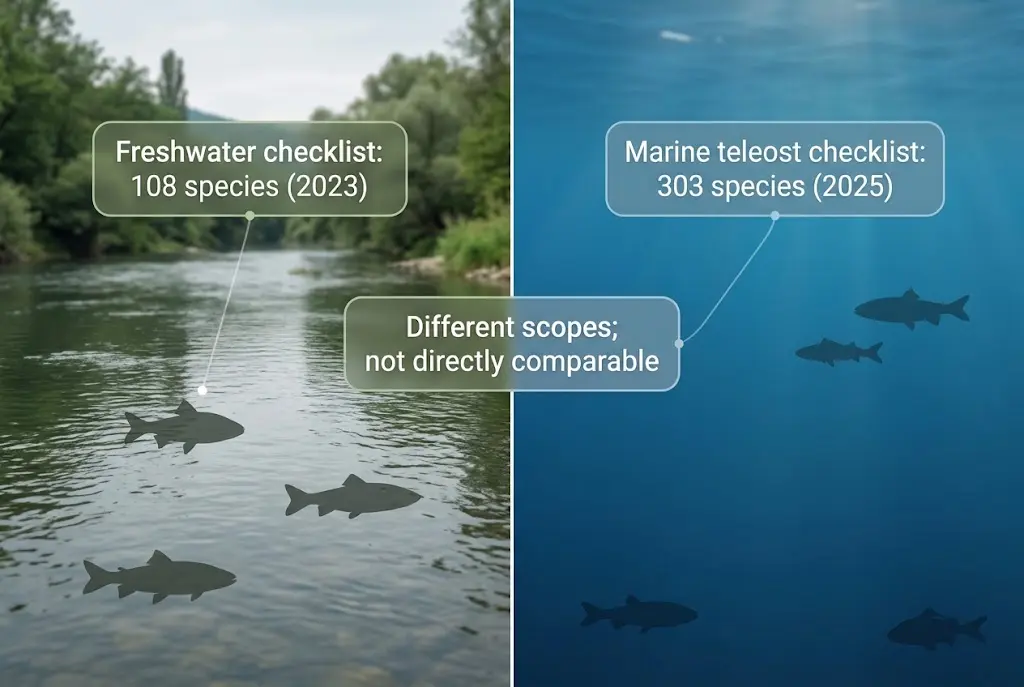
The 2023 revision by Saad and colleagues confirms 108 freshwater fish species in 15 orders, 25 families and 51 genera, and it excludes 17 species previously reported from Syria. Cypriniformes account for 68 species. Catfish orders follow with nine, cichlids with eight, mullet-like fishes with seven and killifish-like fishes with six. At family level, cyprinids contribute 30 species, 27.8 percent of the total, then leuciscids with 21, nemacheilid loaches with 11, cichlids with eight and mullets with seven.
The seven mullets are a warning against reading the word “freshwater” too literally. Mullets tolerate changing salinity and enter estuaries and the lower courses of rivers. A river, a reservoir and a coastal lagoon can share a checklist while offering different habitats. The Euphrates–Khabur system, the Orontes, the coastal drainages, the Barada and Awaj, and the Yarmouk are separate biogeographic units in this literature.
Endemic, Native, and Introduced Fish
Eleven of the 108 species, 10.2 percent, are alien. Six, 5.6 percent, are treated as endemic to Syria. Introduced fishes in the checklist’s taxonomic treatments include common carp, Cyprinus carpio, silver carp, Hypophthalmichthys molitrix, grass carp, Ctenopharyngodon idella, and Carassius species, all familiar aquaculture fishes. They illustrate the alien total; they are not the whole list of eleven. Competition, predation and a changed food base are plausible effects. Demonstrating those effects in a named Syrian river requires a site study.
Endemism here can mean a spring or an upper river, not a whole country. Oxynoemacheilus shehabi, a small loach, was described in 2021 from the upper Orontes in southern Syria. That kind of range is why an endemic fish can be missed by a national overview written from the Euphrates, and why older lists that copy unreviewed records become unreliable. The 2023 checklist’s decision to drop 17 previously reported species is itself a result.
Threatened Freshwater Fish
Among 97 naturally distributed species, the checklist treats Tristramella sacra as Extinct and places 24 species in the threatened categories: eight Critically Endangered, eight Endangered and eight Vulnerable. The authors state that the 24 equal 26.5 percent. That percentage is theirs, tied to the assessment set they used, and is not recalculated here as a simple fraction of 97. Dams, pollution, water extraction and introduced predators are credible mechanisms. The checklist establishes which species are in trouble under Red List criteria; it does not assign a share of blame to each mechanism in each basin.
Marine Fish Along the Syrian Coast
Of the 303 bony fishes in the 2025 marine checklist, 48 were recorded during 2018–2025. The authors describe that rate as about seven species a year and as 17.1 percent of the species previously recorded. An earlier checklist, published by Ali in 2018, reported 298 marine fishes across three classes, including sharks and rays, with 56 Lessepsian species, animals that had entered the Mediterranean through the Suez Canal. Subtracting 298 from 303 would confuse a bony-fish list with an all-fish list.
A further 2026 paper by Ibrahim and co-authors separates a related but different question: 50 exotic teleosts newly recorded in Syrian marine waters during 2018–2025, of which six are considered established. Those six are Jaydia smithi, Heniochus intermedius, Fistularia petimba, Platycephalus indicus, Pterois volitans, and Epinephelus areolatus. Fifty exotics are not the same thing as 48 new checklist records. A single stray fish and a species that now breeds locally call for different responses.
| Comparison aspect | Ali (2018) | Ibrahim et al. (2025) |
|---|---|---|
| Taxonomic scope | Marine fishes across 3 classes | Marine bony fishes (Teleostei) |
| Reported total | 298 marine fish species | 303 teleost species |
| Sharks and rays | Included in the broader all-fish scope | Excluded from the 303-species teleost total |
| Additional reported figure | 56 Lessepsian species | 48 species recorded during 2018–2025 |
| How to interpret the totals | A broader taxonomic list | A teleost-specific list; not a direct count increase |
Marine Biodiversity and the Pressures Facing Syrian Waters
Pollution, fishing, disturbance of coastal habitat and the arrival of Red Sea species are all discussed in the Syrian marine literature. The strongest numerical evidence currently in hand is about new records and establishment, not about the decline of a named native fish stock. The High Institute of Marine Research in Latakia is a recurring address on these papers, which explains both the recent gain in knowledge and the remaining dependence on what fishers and shoreline surveys happen to encounter. Open-water cetacean surveys are still largely absent, which is why strandings carry more weight than they should.
Invertebrates and Their Ecological Importance
Syria’s invertebrates include pollinating insects, decomposers, spiders, scorpions, and aquatic invertebrates. The available sources do not establish a single comprehensive national species total for this group, so its ecological roles are more useful here than an unsupported overall count.
Bees, butterflies, and flies pollinate wild plants and crops. Their communities differ between coastal orchards and steppe vegetation. Pesticide use and the loss of flowering field margins can affect pollinators, although the sources reviewed for this article do not establish a national trend in Syrian pollinator abundance.
Beetles and flies that consume dung and carcasses contribute to decomposition, while spiders and scorpions prey on other invertebrates and small animals. Some scorpions are medically important, but that does not make every arachnid dangerous. In aquatic habitats, invertebrates also form part of the food supply for fish and amphibians.
How Syria’s Wildlife Has Changed Over Time
Historical Wildlife Distribution and Modern Records
Comparison is possible where an old record and a new one refer to the same animal and say what kind of evidence each is. Goitered gazelle was reported from the northern Euphrates steppe decades ago and was photographed again near Jabal Abd al-Aziz between 2019 and 2021. Nubian ibex was taken or reported in the Palmyra region in the early twentieth century and is not treated as still living there. Northern bald ibis colonies known from historical itineraries had become seven birds by 2002. Each comparison has its own dates. None of them supports a single national story of unbroken decline.
Species That Have Disappeared From Parts of Their Historical Range
Local disappearance is a high bar. It fits best where suitable searches find nothing, or where a specialist checklist says recent records have stopped, and it should keep the checklist’s own uncertainty. The ibex account says the species might have been gone from Syria by the late 1950s, then records a 1970 reintroduction in the Golan. Tristramella sacra is listed as extinct as a species in the freshwater checklist. The Palmyra ibis colony is treated as probably finished as a breeding population, while the species persists in Morocco. “Extinct,” “extinct here,” and “not seen on the last visit” are not interchangeable.
Habitat Loss and Changes in Land Use
Drainage of the Ghab, conversion and heavy grazing in the steppe, roads and canals, and the use of Sabkhat al-Jabbul as an outlet for irrigation drainage are documented changes in land and water. Fragmentation is selective. It can block a gazelle’s movement between feeding grounds and water, isolate a spring fish, and at the same time create edges that suit foxes and jackals. A national species list can stay long while its contents shift.
Wildlife Reintroduction and Population Recovery
Al-Talila, east of Palmyra, is the clearest Syrian case of the difference between release and recovery. An FAO project account says Arabian oryx, Oryx leucoryx, by then extinct in Syria, and sand gazelles reduced by hunting were brought to the reserve in late 1996: eight oryx and 30 gazelles. The same account later reports 38 oryx and 300 gazelles. The release area was about 10 square kilometres, because the reserve could not feed free-ranging herds and because animals that left were likely to be hunted. Supplementary food and water were part of the design. Those numbers show breeding inside a managed, fenced system during the life of the project. They do not show oryx restored to the open steppe, and they are not a current census. Peer-reviewed counts for the years after monitoring was disrupted were not available here.
The Challenges of Monitoring Wildlife in Syria
A phone photograph, a museum skin and a survey from 2006–2023 are not the same kind of evidence as a hunting note from 1930. More marine-fish records after 2018 can mean new arrivals, more observers, or both. Fewer hyena reports from a district can mean fewer hyenas or fewer people writing them down. For the bald ibis, the colony was already collapsing because young birds died away from the breeding grounds and because breeding success fell; the conflict then stopped the monitoring that might have distinguished a temporary gap from an ending. Direct damage, interrupted management and inaccessible field sites are three different problems. War is not, by default, the measured cause of every uncounted decline.
How Scientists Confirm the Presence of an Animal in Syria
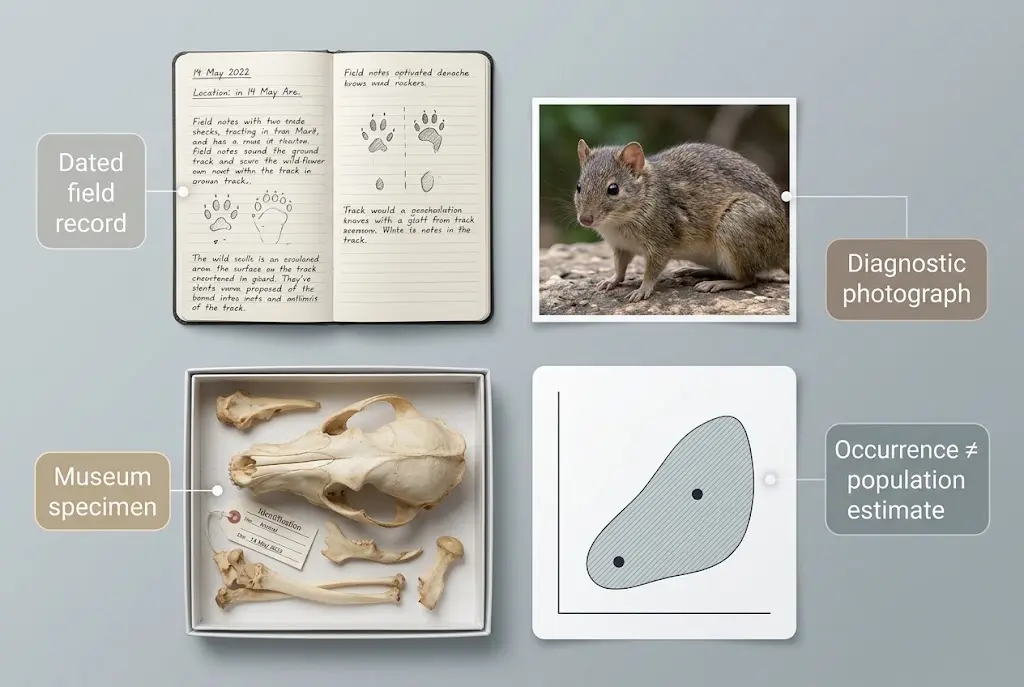
A specimen with a place and a date is stronger than an unnamed sighting. A photograph that shows diagnostic features can be enough for many birds and large mammals. Rodents and bats often need a skull, measurements or a recording. The mammal checklist says outright that it used literature, grey data, photographs and fieldwork, which means the lines inside it are not all equally secure.
An old record establishes past presence. Maydon’s 1930 ibex report says something about the Palmyra hinterland at that date. It says nothing about 2025. A goitered-gazelle photograph from 2019–2021 establishes recent presence of that species at that place, not the welfare of sand gazelles at Al-Talila.
The terms that keep these records straight are ordinary but not optional. A resident species completes its year in the country. A migrant moves on a seasonal pattern. A vagrant is outside its usual route. An introduced species arrived through human action, even if it later breeds. An endemic species has a naturally restricted range. A species can be endemic to a Syrian spring and still be globally threatened for that very reason. Global Red List status comes from the IUCN assessment for the whole species. Local decline needs a series of counts or another direct indicator. Local extinction is a conclusion, used when appropriate surveys no longer find the animal, and it stays provisional where large areas remain unvisited.
Checklists change for editorial as well as biological reasons. Splitting the sand gazelle from the goitered gazelle, raising the Nubian ibex to species rank, deleting 17 fishes, and adding 21 birds since 2008 all alter the table. Sometimes the animal changed its range. Sometimes a name was corrected. The date and the source belong with the number.
Do not treat these labels as five competing answers to the same question. Each label refers to a different attribute of a record or population.
A species that completes its annual cycle in the country.
A species that moves seasonally. The article distinguishes summer visitors, winter visitors and passage migrants.
A species whose arrival resulted from human action; an introduced species may later live free in the wild.
Examples flagged in the mammal checklist include coypu and brown and black rats.Evidence of presence at an earlier date. An old record alone does not establish current presence.
The article discusses a Nubian ibex report from the Palmyra region in 1930 as historical evidence.A population is considered absent from a specified area; the conclusion depends on the evidence and the adequacy of searches.
The Syrian northern bald ibis breeding population is described as probably gone; this does not mean the species is extinct worldwide.How to combine the terms: Origin, movement, evidence date and local status answer different questions. A record can have more than one supported descriptor; for example, “introduced” concerns origin, while “resident” or “migratory” concerns presence or movement. “Historical” identifies the date of evidence, not a population trend.
Scientific scope note: A checklist category or historical occurrence is not, by itself, a current population estimate. Local extinction claims should retain the source’s geographic scope and uncertainty.
Threats to Wildlife in Syria
Habitat loss and fragmentation affect forests, steppe, wetlands and coasts differently. Drainage, roads, urban growth and canals reduce the connected ground animals need for feeding, breeding and movement. Species tied to one spring or one breeding beach feel that first. Species that live on edges may not.
Illegal hunting and trade are documented as pressures rather than as national totals. Law No. 14 of 2023 requires a hunting licence and a licensed weapon, creates a Central Council for Wild Hunting in the Ministry of Agriculture and Agrarian Reform, and prohibits hunting inside towns, villages, reserves and their buffers. The legal season runs from 1 September to 15 February, in daylight. Trade in live or dead game and in their parts is restricted unless the council decides otherwise. The law is evidence of a rule. The hyena killings publicized in 2026, and the hunting risk that led Al-Talila’s planners to build a fence in the 1990s, are evidence that the rule is not the same thing as compliance. Neither source measures the national offtake.
Water scarcity and wetland degradation are visible in two opposite histories. The Ghab lost its marsh to drainage. Jabbul gained water from irrigation drains and, with it, pollution and unstable salinity, which the 2006 study already listed alongside hunting and damaged shore vegetation. A spring that supports an endemic loach can fail without any change in a national rainfall average. Migratory birds then lose a stopover, and amphibians lose the aquatic stage of their lives.
Overgrazing changes the shrubs that feed gazelles and hide ground-nesting birds. Fire at Fronloq left bird communities poorer than those in oak, in the samples studied. The careful claim is about habitat structure, not that every fire empties a landscape. Pollution and pesticides are established risks for aquatic animals and pollinators elsewhere; for Syria, the firmest available numbers concern which fishes have been introduced and which marine species have become established, not a measured percentage of decline caused by a named chemical.
Conflict adds direct physical damage, the collapse of wardening, and the simple inability to repeat a survey. Those can be stated only where a record supports them. For the bald ibis, monitoring stopped, and the biological decline had already been measured. For Al-Talila, the managed herds of the late 1990s cannot be carried forward as if the fence, the wells and the counts had continued unchanged. For most other species, an unsurveyed decade is an unsurveyed decade.
Wildlife Conservation in Syria
A protected area, an Important Bird Area, an important plant area and a Ramsar site are different designations. Sabkhat al-Jabbul carries more than one of them, with boundaries that do not coincide. Fronloq is a forest reserve with a published bird study. Abu Qubays is recognized for plants. Jabal Abd al-Aziz matters in plant assessments, older bird inventories and recent gazelle records. Al-Talila was built for desert ungulates inside a managed system. Umm al-Tuyour, Slenfeh and the Euphrates valley are bird sites with different jobs. A scientist’s recommendation is not a decree, and a decree is not a budget or a guard post.
Syria is a party to the Convention on Biological Diversity. Its country file is useful for the shape of national commitments, but older figures and draft material in that file should not be recycled as present-day statistics. The Ramsar Convention entered into force for Syria on 5 July 1998. Sabkhat al-Jabbul, site 935, is the Ramsar site confirmed in the sources used here. A national report to the fifteenth conference of the parties of the Convention on Migratory Species, dated 28 November 2025, shows that official reporting continues. Reporting is not field protection. Hunting Law No. 14 of 2023 is the specific domestic instrument for wild hunting; the 2006 animal-health law is about livestock disease and should not be mistaken for it.
The checklists published from 2023 to 2025 are the practical base for any later protection. They come largely from Syrian institutions and their co-authors: the agricultural research commission in Deir ez-Zor, Tishreen University’s marine institute, and aquatic-ecology specialists including Adib Saad, together with Ahmad Aidek and Amir Ibrahim across mammals, reptiles, amphibians, birds and fishes. The useful next step is not another undifferentiated list. It is repeated counts of a few populations already known to matter: goitered gazelle on the Abd al-Aziz steppe, fishes of the upper Orontes, nesting beaches, the main waterbird sites, and strandings along the coast.
Habitat protection does more work than a single-species announcement. The Aleppo countryside matters to the golden hamster, the upper Orontes to a loach, the water regime of Jabbul to flamingos and ducks, and a small number of beaches to nesting turtles. The bald ibis showed how a rare species can draw attention; the steppe where it fed was still the object that needed protecting.
People who hunt, herd, fish and farm see animals between surveys. Their useful role is practical: reporting strandings, avoiding the broadcast of nest locations to other hunters, and reducing poison and indiscriminate killing. Beliefs that treat a hyena’s body as medicine or a snake as a category of evil are part of the conservation problem. Correcting them means explaining what the animal does and what the evidence shows.
The documented pattern is geographic. A gazelle with a recent record on the Jazira steppe, a forest bird community measured oak by oak at Fronloq, a duck count at Jabbul that is only as good as its year, a loach known from the upper Orontes, and a whale known because it washed ashore are all wildlife of Syria. They are not one population, and they cannot be protected as if they were.
The article relies on group-specific checklists, dated site records and conservation databases:
- Aidek et al. (2025), checklist of Syrian mammals, Zootaxa.
- 2025 annotated bird checklist publication summary; the study appeared in Jordan Journal of Natural History.
- Aidek et al. (2024), turtles and tortoises of Syria, Zootaxa.
- Saad et al. (2023), revised checklist of Syrian freshwater fishes, Zootaxa.
- BirdLife International, Syria country factsheet and Important Bird Area information.
- Ramsar Sites Information Service, Sabkhat al-Jabbul, site 935.
- Key Biodiversity Areas factsheet for Sabkhat al-Jabbul.
- IUCN/BirdLife account for the northern bald ibis; the article retains the assessment date and qualification.
- FAOLEX summary of Syrian Hunting Law No. 14 of 2023.
Sources
The 25 references below reproduce the supplied updated bibliography. Links are included where a DOI or record URL was supplied or already cited; no missing publication URLs have been guessed.
Showing 25 of 25 references.
Bibliographic check before publication: The updated list supplied here gives the Freyhof and Geiger DOI as 10.11646/zootaxa.4908.4.9, while the preceding article cited 10.11646/zootaxa.4908.4.7. Verify the DOI against the publisher record. Also confirm the issue and publication-year details for the 2026 marine teleost checklist against the journal record.
Encyclopedia of Syria presents the material as a dated synthesis of the sources cited, not as a substitute for specialist field identification, legal advice or a new national survey.