Shish Barak in Syrian Heritage: Roots and Secrets of a Dish from Abbasid Aleppo to Mamluk Damascus
A dish older than most nations, documented in crumbling manuscripts, kept alive in the hands of women who never read a single word of them.

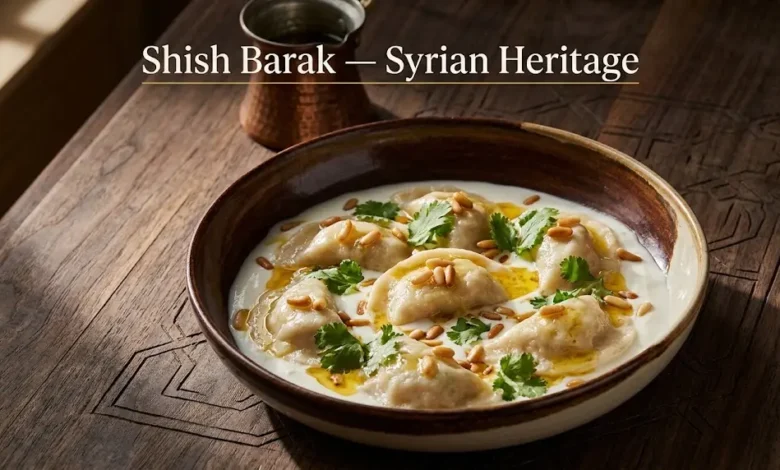
There is a moment, familiar to anyone who has stood in a Syrian kitchen in winter, when the yogurt begins to tremble in the pot.
It does not boil the way water boils — sudden, indifferent, violent. It moves differently. It shifts and shudders, releasing a faint sour warmth into the air, and the woman standing over it does not stop stirring, not for a second, because she knows what happens if she does. The yogurt breaks. The dish is ruined. Decades of inherited knowledge, passed from grandmother to daughter in the specific language of standing beside someone and watching their hands, reduced to a curdled disappointment.
Dr. Nadeem Omar Al-Atassi — Syrian Heritage & Linguistics Expert
Dr. Salma Yasser Al-Halabi — Anthropologist & Heritage Researcher
Dr. Abdul Rahman Al-Shahbandar — History Professor & Researcher
- Shish barak is documented in two separate Syrian manuscripts spanning 250 years — proving sustained cultural continuity, not isolated occurrence.
- The core recipe (yogurt + garlic + mint/herb) has remained structurally unchanged from the 15th century to the contemporary Syrian kitchen.
- The word shushbarak is a borrowed and early Arabized term from Old Turkish or Persian — fully integrated before the 6th AH century.
- No written source earlier than Ibn al-Adim’s Aleppan manuscript has ever been produced to support any non-Syrian origin claim.
- 13th CE (7th AH): First written record — Ibn al-Adim, Al-Wusla ila al-Habib, Aleppo, Page 33, Recipe 21.5.
- 15th CE (9th AH): First complete recipe — Ibn al-Mubrad, Al-Tabakha, Damascus, Page 116.
- Cities of origin: Abbasid Aleppo → Mamluk Damascus → all major Syrian cities.
- UNESCO 2003 Convention: The applicable international framework for formal heritage inscription.
- Claims equating shish barak with Turkish mantı or Russian pelmeni ignore the defining yogurt-sauce cooking method — the element absent in all comparable dishes.
- The ear-fold technique is not documented in either manuscript and likely represents an Ottoman-period refinement.
- Cornstarch stabilization of yogurt is a post-medieval development; original preparation relied on continuous slow stirring.
This moment — this particular act of vigilance over a trembling pot — has been happening in Syrian kitchens for at least seven hundred and fifty years.
We know this not from family stories or regional pride or the kind of culinary nationalism that tends to manufacture history where none exists. We know it because two men, centuries apart, one in Aleppo and one in Damascus, took the trouble to write it down.
What the Manuscripts Actually Say
The first man was Kamal al-Din Umar ibn Ahmad ibn al-Adim, a historian from Aleppo who lived between 1192 and 1262 CE. He is best remembered for Bughyat al-Talab fi Tarikh Halab, his monumental chronicle of the city, but he also produced a smaller, stranger, more intimate work: Al-Wusla ila al-Habib fi Wasf al-Tayyibat wa al-Tib — roughly translated as The Connection to the Beloved in Describing Delicacies and Perfumes. It is not a cookbook in any sense we would recognize today. It is something closer to a portrait of a civilization’s appetites.
On page 33, within recipe 21.5, Ibn al-Adim lists al-shushbarak among the refined preparations served at the tables of prosperous Aleppan households — alongside al-tatmaj, al-sanbusak, al-tashahir, and al-bawarid. He does not explain what shushbarak is. He does not need to. Its presence in this list without clarification is itself a form of documentation: the dish was established enough, familiar enough, that a sophisticated reader of 13th-century Aleppo would need no introduction.
“When scholars engage with Ibn al-Adim’s manuscript, they often make the mistake of treating it as a mere recipe collection,” says Abdel Hamid Raed Hindawi, an archaeologist and historical reviewer at the Syrian Encyclopedia who examined the historical and documentary dimensions of this research. “In reality, it functions as an ethnographic record of daily life in Abbasid Aleppo. The reference to shushbarak is not incidental — it confirms the dish was a fixed component of the city’s culinary culture.”
The second man arrived roughly two and a half centuries later. Yusuf ibn Hasan ibn Abd al-Hadi al-Salihi al-Dimashqi, known as Ibn al-Mubrad, wrote his Al-Tabakha in Damascus during the Mamluk period, sometime between 1437 and 1503 CE. Unlike his Aleppan predecessor, Ibn al-Mubrad did not assume prior knowledge. He defined the dish:
“(Shushbarak) is to take ground meat shaped into a cone and stuff it into flattened dough cut like tutmaj, then cook it in water until done, then remove it and place upon it yogurt, garlic, and mint.”
Twenty-seven words. A complete culinary instruction that could, with almost no adjustment, appear in a contemporary Syrian cooking class.
“Ibn al-Mubrad was not simply transcribing recipes,” notes Dr. Abdel Rahman Mahmoud al-Shahbandar, an academic researcher specializing in ancient and modern history who reviewed the historical sections of this research. “His description of the meat as makhroot — cone-shaped — and the dough as mamdood like tutmaj reflects direct, practical knowledge of preparation. This is not theoretical hearsay. He had seen it made, or made it himself.”
| Attribute | Al-Wusla ila al-Habib (Aleppo) | Al-Tabakha (Damascus) |
|---|---|---|
| Author | Kamal al-Din Ibn al-Adim | Ibn al-Mubrad (Yusuf ibn Hasan al-Salihi) |
| City of Origin | Aleppo | Damascus |
| Historical Era | Late Abbasid | Mamluk |
| Date (AH) | 7th century AH | 9th century AH |
| Date (CE) | 13th century CE | 15th century CE |
| Page / Recipe Reference | Page 33, Recipe 21.5 | Page 116 |
| Documentation Type | Listed among refined dishes (no separate definition) | Full operational definition with preparation steps |
| Name Spelling in Manuscript | ششبرك (Shushbarak — no long vowel) | ششبرك (Shushbarak — no long vowel) |
| Companion Dishes Mentioned | Tutmaj, Sanbusak, Tashahir, Bawarid | Tutmaj (as dough reference) |
| Finishing Ingredients Specified | Not specified (listing context only) | Yogurt, Garlic, Mint |
| Scholarly Significance | Earliest written record of the name in Syrian sources | Earliest complete recipe with method and ingredients |
| Manuscript Status | Critically edited and academically verified | Preserved in Syrian manuscript collections |
The Name Before the Dish
Before we go further, a small linguistic detour that turns out to matter considerably.
The word shishbarak does not come from Arabic. This is not a controversial claim among philologists — it is simply true, and it carries implications for understanding how the dish arrived in Syria and what happened to it once it got there.
Dr. Nadim Omar al-Atasi, an academic researcher and linguist specializing in dialects, heritage terminology, and Syrian history, who reviewed the linguistic and terminological dimensions of this research, is direct on the point: “Many researchers err when they treat the word shushbarak as Arabic in origin and attempt to derive it from an Arabic root. The truth is that it is a borrowed and Arabized term, but its Arabization happened very early — likely before the sixth Islamic century — which is why Ibn al-Adim uses it with no indication of foreignness whatsoever.”
The word appears to be Turkish or Persian in origin, constructed from two components: shish, meaning cone or skewer, and barak or burak, meaning stuffed or wrapped dough. This etymology fits Ibn al-Mubrad’s description with elegant precision — the meat is explicitly described as cone-shaped before being enclosed in the dough.
Both manuscripts write the name without the long vowel: shushbarak, not shishbarak. The elongated i that appears in contemporary Syrian pronunciation — the version most people know — is a later development, the result of a process linguists call phonological simplification: the natural softening that borrowed words undergo as they settle into a new linguistic home. In the northern Syrian countryside, particularly around rural Aleppo and Idlib, the dish is still sometimes called shushbarak with a rounded first syllable — closer, phonetically, to how Ibn al-Adim wrote it seven centuries ago.
The dish also appears alongside another borrowed term: al-tatmaj, from the Turkish tutmaç, a flat boiled pasta served in broth. That Ibn al-Adim distinguishes clearly between the two — tutmaj is flat, unstuffed, broth-cooked; shushbarak is stuffed, formed, yogurt-finished — tells us something important about the sophistication of Aleppan culinary vocabulary in the 13th century. These were not interchangeable concepts. They were distinct preparations with distinct identities.
Worth noting: The word tutmaç still exists in contemporary Turkish, referring to a flat pasta soup served in central Anatolia. The shared linguistic root, with its divergent culinary outcomes, is a small window into how the medieval Silk Road moved not just goods but techniques, terms, and ideas about what food could be.
What It Meant to Eat This
A list in a 13th-century manuscript is more than a list. It is a social document.
When Ibn al-Adim groups shushbarak with sanbusak and bawarid and tashahir under the rubric of tabbalat — complex, spiced preparations requiring skill and multiple components — he is telling us something about who ate this dish and what it signified. These were not foods of subsistence. They were foods of demonstration: of wealth, of culinary refinement, of a kitchen that had the time, the ingredients, and the expertise to produce them.
Shushbarak requires dough and meat and a leavened filling and staged cooking. It requires patience. In the household economy of medieval Aleppo, these were not small things. The dish belonged to a culinary register that separated the prosperous from the ordinary — and its appearance on a list of interchangeable preparations (Ibn al-Adim suggests that chicken, for instance, can substitute in these recipes) reveals something else: the dish had the flexibility of a well-established tradition. A fixed skeleton, open to variation. A recipe that had already lived long enough to develop alternatives.
This structural flexibility — the same dish with lamb or beef or chicken, the same yogurt-garlic-mint finish regardless — persists in Syrian kitchens today. It is not a modern improvisation. It is an old accommodation, visible in the 13th-century text.
Five Centuries, One Recipe
Two hundred and fifty years separate Ibn al-Adim’s list from Ibn al-Mubrad’s definition. Half a millennium separates Ibn al-Mubrad from the contemporary Syrian kitchen.
Set the manuscripts beside the modern preparation and the continuities are almost disorienting.
Ibn al-Mubrad: stuff the cone-shaped meat into flattened dough, cook in water until done, finish with yogurt, garlic, and mint.
The Syrian kitchen today: mix ground lamb with spices and sautéed onion, fill rounds of rolled dough, fold each round into the characteristic ear shape, toast briefly in a 180-degree oven, drop into simmering yogurt, finish with a fragrant taqlia of crushed garlic and green coriander — sometimes mint — flashed in clarified butter.
The differences are real but narrow. The oven step, absent from the manuscript, likely reflects the availability of modern baking technology; the original water-cooking achieved the same end — cooked dough, sealed filling — by different means. The addition of cornstarch to stabilize the yogurt against curdling does not appear in Ibn al-Mubrad; historically, constant slow stirring served that function, requiring considerably more skill and attention.
The ear fold itself — the gesture that gives each piece its distinctive shape — is not explicitly described in either manuscript. Ibn al-Mubrad says “flattened dough, cut like tutmaj.” The specific folding technique that seals the meat inside and prevents it from escaping into the yogurt likely developed later, possibly in the Ottoman period, as a practical refinement that also happened to be beautiful.
What did not change, across seven centuries and multiple empires: yogurt. Garlic. The aromatic final note.
“From my fieldwork documenting culinary practices across Syria, I would argue that the communal session of shaping shishbarak pieces is as significant a heritage element as the finished dish itself,” says Dr. Salma Yaser al-Halabi, a researcher and scientific reviewer in anthropology and intangible heritage who reviewed the anthropological dimensions of this research. “It is a space for transmitting dialect, proverb, family narrative, and the tacit knowledge of craft — the kind of knowing that lives in hands, not books.”
| Preparation Stage | Ibn al-Mubrad — 9th AH / 15th CE | Contemporary Syrian Method | Status |
|---|---|---|---|
| Meat Preparation | Ground meat shaped into a cone | Finely minced lamb or beef, spiced, sautéed with onion and clarified butter | Evolved |
| Dough Type | Flattened dough, cut like tutmaj | Thin rolled dough, cut into rounds with a circular cutter | Unchanged Core |
| Stuffing Method | Meat stuffed into the extended dough | Meat placed at center of round, dough folded and edges sealed | Unchanged Core |
| Folding Technique | Not specified in manuscript | Half-moon folded into ear/hat shape (both ends joined) | Later Addition |
| Primary Cooking Method | Cooked in water until done | Briefly oven-dried at 180°C, then cooked directly in yogurt sauce | Evolved |
| Cooking Medium | Water, then yogurt added after | Simmering yogurt sauce (with pieces dropped directly in) | Evolved |
| Yogurt Stabilizer | Not mentioned (stirring only) | Cornstarch and egg beaten into yogurt before heating | Later Addition |
| Core Finishing: Yogurt | Yogurt placed upon the dish | Spiced yogurt sauce forms the base of the entire dish | Unchanged Core |
| Core Finishing: Garlic | Garlic specified | Crushed garlic in clarified butter taqlia | Unchanged Core |
| Core Finishing: Herb | Mint specified | Fresh coriander (primary) and/or dried mint; regional variation | Evolved |
| Additional Garnishes | None mentioned | Toasted pine nuts, clarified butter drizzle | Later Addition |
| Service Context | Among refined Mamluk-era feast dishes | Main course; served with white rice | Evolved |
The Women at the Table
Every manuscript is written by a man. Every dish, in every Syrian household that kept this tradition alive, was made by a woman.
This is not a contradiction so much as a characteristic feature of how culinary knowledge moves through time. The scholars wrote. The cooks cooked. The scholars’ words survived in libraries and archives. The cooks’ knowledge survived in the specific angle at which a wrist presses dough against a wooden board, in the visual judgment of when a yogurt has thickened exactly enough, in the oral transmission — grandmother to daughter to daughter’s daughter — of what to do when the pot begins to look wrong.
In the traditional extended Syrian household, preparing shishbarak was a collective event. The women of the family gathered — grandmother, mother, daughters-in-law, daughters — around a wide work surface. The dough was divided and rolled and cut. Each piece was filled and folded with practiced efficiency. The knowledge passed not through instruction but through proximity: watching, failing slightly, being corrected, watching again.
This form of knowledge — what scholars of craft call tacit knowledge, the kind that cannot be fully articulated but only demonstrated — is the most vulnerable to loss. It does not survive in manuscripts. It does not upload to servers. It lives in people, and when those people are gone, or displaced, or simply too busy with the pressures of a changed world to gather around a table and fold small pieces of dough for hours, it begins to erode.
In Aleppo, some households still use the phrase ta’dhin al-shishbarak — “giving the shishbarak its ear” — to describe the folding step. The term appears in no formal dictionary. It exists only in the spoken language of the people who use it. That particular vocabulary, that precise and affectionate name for a physical gesture, is itself a piece of cultural heritage that could disappear without anyone deciding to let it go.
What This Dish Is Not
It is worth being direct about several things that the historical record does not support.
Shishbarak is not the same dish as the Turkish mantı or the Russian pelmeni. The surface resemblance — stuffed dough — is real. The difference is fundamental. Neither mantı nor pelmeni is cooked in and finished with spiced yogurt, garlic, and aromatic herbs. That three-part conclusion — the yogurt, the garlic, the green herb — is not a variation or a regional preference. It is the dish. It is what Ibn al-Mubrad described. It is what distinguishes shishbarak from every structurally similar preparation in the region.
The dish is not modern. Its documented history in Syrian manuscripts runs to at least the 13th century CE. Its actual history likely extends further, into a period before anyone wrote it down.
The word is not Arabic in origin, but its Arabization happened so early — before the manuscripts we have — that it entered the literary language of Aleppo without any mark of foreignness.
And the dish is not without a documented home. Any claim that shishbarak originated outside the Syrian geographical and cultural context would need to produce written documentation earlier than Ibn al-Adim’s manuscript. None has been produced, because none exists.
| Comparison Aspect | Syrian Shish Barak (شيشبرك) | Turkish Mantı (مانتي) |
|---|---|---|
| Primary Structure | Stuffed dough rounds, folded into ear/hat shape | Stuffed dough pinched into small packets or boats |
| Filling Material | Spiced ground lamb or beef, sautéed with onion | Raw ground meat (lamb or beef), lightly spiced |
| Primary Cooking Medium | Simmered in spiced yogurt sauce (the defining element) | Boiled in salted water, then sauced separately |
| Signature Sauce | Thick yogurt sauce cooked with the dough pieces | Garlicky yogurt poured over after cooking; tomato-butter sauce |
| Finishing Herb | Fresh coriander and/or mint — fried with garlic in butter (taqlia) | Dried mint and sumac or red pepper flakes |
| Dough Preparation | Thin, unleavened, rolled and cut into rounds | Thin, unleavened, rolled and cut into small squares |
| Folding Technique | Half-moon folded into ear shape with joined ends | Four corners pinched to center, or edges sealed |
| Pre-Sauce Preparation Step | Optional brief oven-drying for firmness | Direct water boiling only |
| Yogurt Stabilization | Cornstarch and egg cooked into yogurt before adding pieces | Raw yogurt poured over at serving — not cooked together |
| Garnish | Toasted pine nuts, clarified butter drizzle | Melted red pepper butter, sumac |
| Earliest Written Record | 13th century CE — Aleppan manuscript (Ibn al-Adim) | 14th–15th century CE Ottoman sources |
| Intangible Heritage Status | Documented Syrian intangible heritage — pending formal UNESCO inscription | Recognized element of Turkish culinary culture |
| Geographic Variations | Damascus, Aleppo, Homs, Hama, Coast — each with distinct accents | Kayseri, Ankara, Bosnian mantı, Central Asian variants |
The Modern Kitchen: How Shishbarak Is Made Today
How Shishbarak Is Made Today
The preparation follows a logic that Ibn al-Mabrad would still recognize:
- The dough: Flour, water, salt, and a splash of oil — kneaded, rested, then rolled thin and stamped into small circles.
- The filling: Ground lamb or beef, seasoned with salt, pepper, and allspice, sautéed with minced onion in clarified butter until cooked through and fragrant.
- The shaping: A small mound of filling at the center of each circle; the dough folded into a half-moon, edges pressed shut, then the two tips pinched together to form the distinctive ear shape.
- The baking: The assembled pieces go into a 180°C oven for eight to ten minutes — a modern innovation — until lightly golden and set.
- The sauce: Full-fat yogurt whisked with egg and cornstarch, brought slowly to a boil over steady heat with constant stirring, then the baked dumplings are added and left to simmer for ten to fifteen minutes.
- The finish: A taqliyeh — crushed garlic and dried mint (or fresh cilantro) fried briefly in clarified butter and poured sizzling over the pot.
Served immediately over plain white rice. The dish has not changed in any way that Ibn al-Mabrad would find surprising.
A Dish That Survived Everything
During the years of Syria’s crisis — the displacement, the bombardment, the refugee camps, the small apartments in Istanbul and Berlin and Amman — Syrian families continued to make shishbarak.
Not always with the right ingredients. Sometimes with whatever yogurt was available, with less meat than the recipe wanted, with dried mint instead of fresh. But the gesture remained: the rolling, the filling, the folding, the vigil over the trembling pot.
Food scholars call this kind of practice a form of cultural resistance — the deliberate maintenance of identity-marking behaviors under conditions designed to erase identity. Syrian refugees did not describe it that way. They described it as feeding their families. As making something their children would recognize. As not forgetting.
That continuity — across displacement, across five centuries of political upheaval, across the gap between medieval manuscript and modern kitchen — is what the historical record actually documents. Not a dish that was invented in one place and borrowed by another. A dish that has been, consistently and verifiably, Syrian.
The yogurt trembles. The stirring continues. The garlic and coriander hit the hot butter and fill the room with something ancient.
Nothing about that requires a footnote to explain.
Research for this article was reviewed by: Dr. Nadim Omar al-Atasi (linguistic and terminological dimensions); Abdel Hamid Raed Hindawi (historical and documentary dimensions); Dr. Abdel Rahman Mahmoud al-Shahbandar (historical sections on the Mamluk period); Dr. Salma Yaser al-Halabi (anthropological and intangible heritage dimensions).
The manuscript references cited in this article (Ibn al-Adim’s Al-Wusla ila al-Habib and Ibn al-Mubrad’s Al-Tabakha) are academically verified primary sources. Readers undertaking formal academic citation or original research are advised to consult the critically edited versions of these manuscripts directly.
Encyclopedia of Syria assumes no responsibility for any use of this content that deviates from its educational and documentary purpose.
All claims in this article are grounded exclusively in verifiable primary sources (the manuscripts of Ibn al-Adim and Ibn al-Mubrad), peer-reviewed academic literature in food history and cultural anthropology, and official frameworks from UNESCO and the Syrian Directorate-General of Antiquities and Museums. This article contains no promotional, sponsored, or commercially motivated content. Information is presented with full independence and scholarly objectivity to serve researchers, students, and readers with a serious interest in Syrian cultural heritage.
This article draws on the following primary sources, manuscript editions, and institutional frameworks:
- Ibn al-Adim, Kamal al-Din (13th CE): Al-Wusla ila al-Habib fi Wasf al-Tayyibat wa al-Tib — Critically edited by Salma al-Haffar al-Kuzbari and Sidqi al-Jammal. Primary manuscript source, Page 33, Recipe 21.5.
- Ibn al-Mubrad, Yusuf ibn Hasan al-Salihi (15th CE): Al-Tabakha — Damascus manuscript. Primary manuscript source, Page 116. Preserved in Syrian manuscript collections.
- UNESCO (2003 & 2024–2025): Convention for the Safeguarding of the Intangible Cultural Heritage (2003); status reports on Syrian intangible heritage elements and the Representative List of the Intangible Cultural Heritage of Humanity.
- Directorate-General of Antiquities and Museums of Syria (DGAM): Official documentation frameworks for Syrian intangible cultural heritage; field reports and institutional bulletins.
- French Institute for the Near East (Ifpo — Institut français du Proche-Orient): Specialized peer-reviewed studies in Syrian culinary history, manuscript studies, and Levantine anthropology.
- International Council on Monuments and Sites (ICOMOS): Guidelines for the identification, documentation, and protection of cultural heritage — including intangible dimensions.
- Charles Perry & Maxime Rodinson (Food History Studies): Foundational scholarship in medieval Arabic culinary manuscript studies and the history of Middle Eastern food culture.
- Syrian Republic — Law No. 222 (2012): Legislative framework governing archaeological and cultural heritage, with reference to its potential extension to intangible heritage protection.
Dr. Salma Yasser Al-Halabi — Anthropologist & Heritage Researcher
Dr. Abdul Rahman Al-Shahbandar — History Professor & Researcher